 Cykeo RFID IoT Solution Products R&D Manufacturer
How RFID Access Control System Works
1031Discover how RFID access control systems work—from tags to readers and control panels. Learn how they improve security, automate entry, and enhance facility access management.
MoreAll RFID Product
Job RFID enables organizations to identify workers, tools, and assigned assets automatically using RFID technology. It improves job tracking, equipment accountability, task visibility, and operational efficiency while reducing manual recording errors across industrial workplaces.
After participating in RFID deployments for factories, maintenance workshops, logistics centers, and utility companies over the past decade, I’ve noticed one recurring pattern. Companies rarely lose visibility because they lack data—they lose it because information is recorded too late or not at all. Paper logs are forgotten, barcode scans are skipped during busy shifts, and shared tools quietly move between teams. A well-designed job RFID system changes that by capturing events automatically as work happens rather than asking employees to stop and record them.
A job RFID system combines RFID tags, readers, software, and business rules to associate people, equipment, and work assignments automatically.
Instead of manually documenting every movement, RFID captures information in real time.
Typical identification objects include:
The objective is not simply knowing where an asset is, but understanding who used it, when it was issued, and when it was returned.
Digital manufacturing depends on accurate operational data.
Yet many facilities still rely on handwritten sign-out sheets or spreadsheet-based equipment records.
During one customer implementation, maintenance personnel spent nearly half an hour at the beginning of each shift locating calibrated instruments. The issue wasn’t missing equipment—it was missing visibility.
After RFID-enabled tool assignment was introduced, technicians could immediately identify available equipment, verify responsibility, and record borrowing automatically.
The operational improvements were noticeable:
| RFID Capability | Operational Benefit |
|---|---|
| Automatic employee identification | Eliminates manual sign-in |
| RFID tool assignment | Improves accountability |
| Real-time borrowing records | Faster audits |
| Asset return verification | Reduces equipment loss |
| Work order association | Better maintenance traceability |
| Inventory visibility | Less time searching for assets |
Rather than adding another administrative task, RFID quietly records activity in the background.
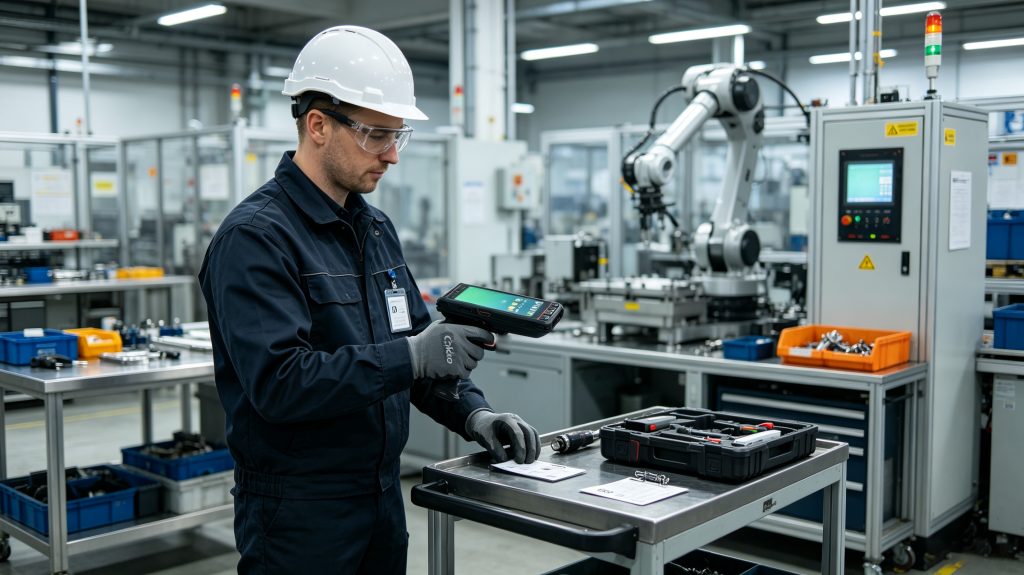
Although often associated with manufacturing, job RFID supports a much wider range of industries.
Track operators, production tools, fixtures, and inspection equipment.
Manage field engineers, safety equipment, and maintenance assets.
Monitor shared tools, temporary equipment, and workforce access.
Assign medical equipment to departments while tracking staff usage.
Associate employees with forklifts, scanners, pallets, and outbound shipments.
Successful RFID deployments depend on more than selecting a reader.
Our engineering team evaluates several practical factors before recommending hardware.
Employee badges and industrial RFID tags must maintain consistent readability throughout daily use.
Different workflows require different devices.
Examples include:
Selecting the wrong reader often creates unnecessary workflow complexity.
A modern job RFID platform should integrate with:
This prevents duplicate data entry while maintaining a unified operational record.
According to GS1, organizations implementing RFID standards frequently achieve inventory accuracy exceeding 99%, helping reduce manual counting and improve traceability across supply chains.Industry Evidence Supporting RFID Workforce Management
Meanwhile, RAIN Alliance reports continued global expansion of passive UHF RFID adoption across manufacturing, logistics, healthcare, industrial automation, and asset management, with billions of tags deployed annually.
These industry findings closely reflect what we observe during enterprise deployments where RFID replaces manual identification processes.
One deployment at a heavy equipment service center stands out.
The customer initially expected RFID to reduce inventory time.
Instead, the first measurable improvement came somewhere else.
Tool disputes almost disappeared.
Because every checkout and return was automatically associated with an employee RFID credential, responsibility became transparent without adding paperwork. Supervisors spent less time resolving disagreements, and technicians spent more time servicing equipment.
Sometimes the greatest value of RFID isn’t faster scanning.
It’s eliminating conversations that shouldn’t be necessary in the first place.
That practical perspective has shaped how Cykeo designs RFID workforce management solutions today.
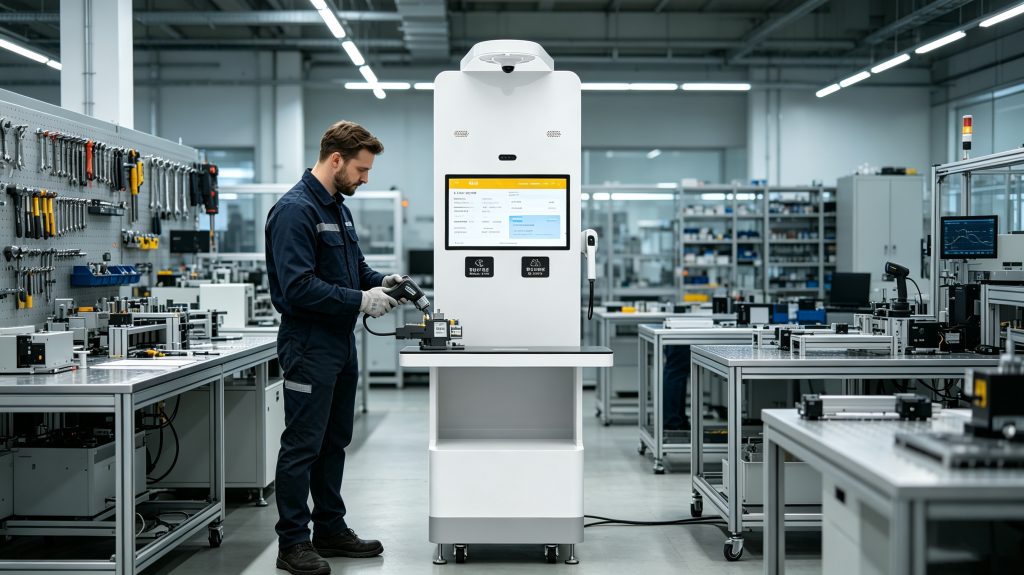
Yes. A single RFID system can associate employee credentials with RFID-tagged equipment, creating complete borrowing and usage records.
Not necessarily. Many organizations operate hybrid environments where RFID complements existing barcode workflows for greater automation.
Yes. Industrial RFID readers and rugged RFID tags are widely used in construction, utilities, mining, and field maintenance applications.
Yes. Cykeo solutions support integration with ERP, MES, CMMS, WMS, and other enterprise management platforms through standard development interfaces.
A modern job RFID solution does far more than automate identification. It creates reliable connections between employees, tools, work orders, and enterprise assets, enabling organizations to improve accountability, operational visibility, and workforce efficiency. With industrial-grade RFID hardware, flexible software integration, and extensive deployment experience, Cykeo helps businesses build scalable RFID systems that support accurate job tracking from assignment to completion.
Discover how RFID access control systems work—from tags to readers and control panels. Learn how they improve security, automate entry, and enhance facility access management.
More
Discover how RFID technology boosts inventory accuracy, cuts costs, and enhances efficiency with case studies from Walmart, Grupo Boticário, and more.
More
RFID linen tags are helping hotels, hospitals, and laundries keep track of sheets, towels, uniforms… not perfectly, but much better than before. A look at how they work, ways to attach them, and what actually happens in real life.
More
The CYKEO CK-B4L is a compact Android UHF RFID Reader designed for software developers and system integrators who need a reliable mobile RFID reader for Android environments. Its 30 cm controlled range, Type-C connection, and developer-friendly SD...
More