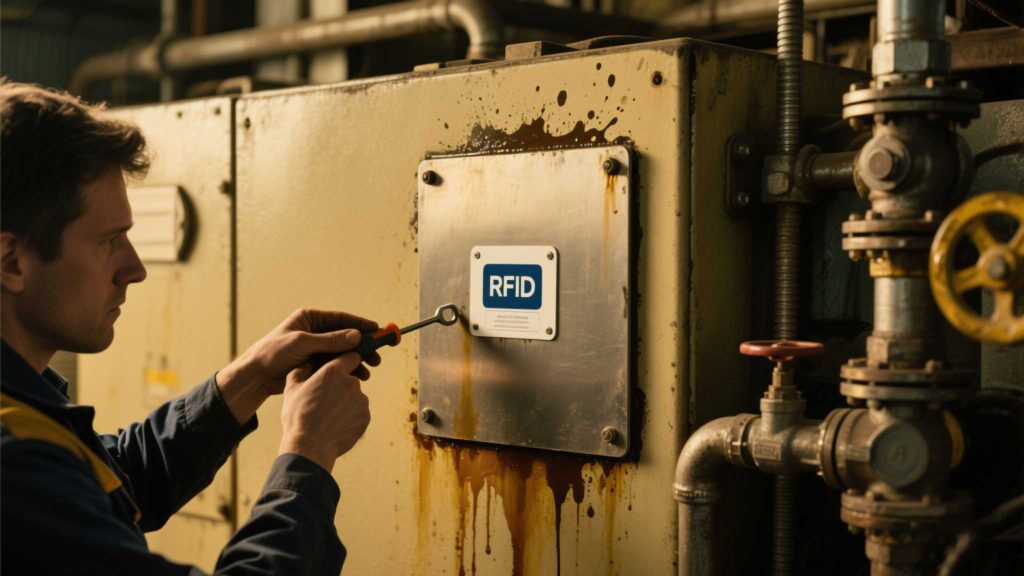
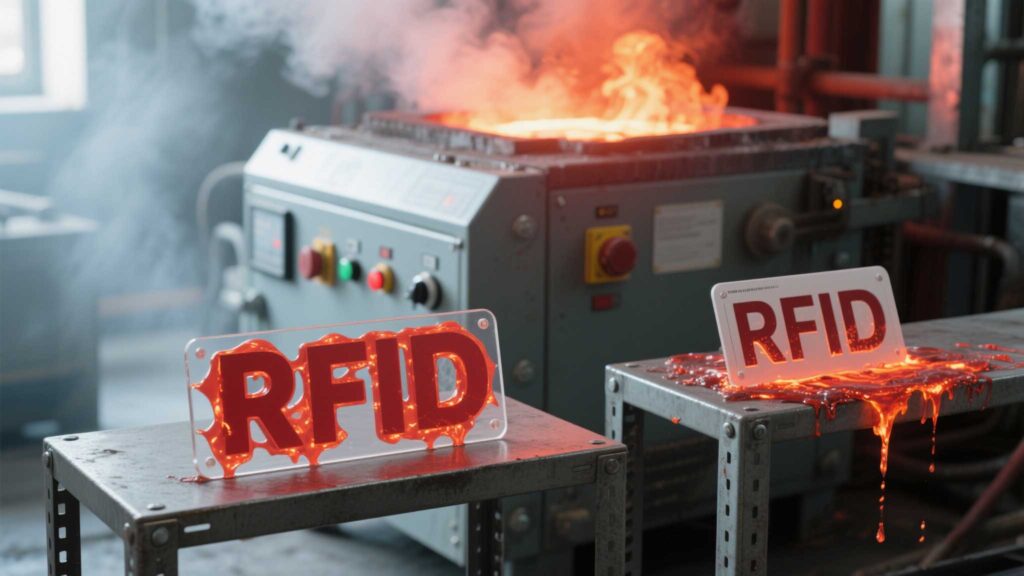
Your factory floor isn’t a lab—it’s a battlefield. Ovens baking parts at 300°F, metal machinery scrambling signals, chemicals eating through flimsy tags. Off-the-shelf RFID? It’ll crash and burn. But here’s the good news: with the right tweaks, you can build RFID tags that laugh at your harshest conditions. Let’s break down how to customize them for your industrial nightmares.
1. When “Standard” RFID Just Won’t Cut It
Scenario: Trying to track metal engine parts in an automotive plant. Problem: Metal reflects RFID signals like a funhouse mirror. Solution:
Anti-Metal Tags: Add foam spacers to lift tags off surfaces.
Low-Frequency (LF) RFID: Uses frequencies that penetrate metal better than UHF.
Pro Tip: Test tags on actual parts—simulated environments lie.
2. Beating the Top 4 Industrial Killers
a. Extreme Heat
Custom Fix: Ceramic or polyimide tags rated for 400°F+.
Avoid: Silicone labels—they melt like ice cream.
Field-Test: 50–100 tags in real conditions for 2–4 weeks.
Measure: Read accuracy, tag survival rate.
Adjust: Swap adhesives, resins, or chip positions.
4. Cost vs. ROI: Why Custom Pays Off
Upfront Cost: Custom tags cost 3–5x more than generic.
Savings:
Reduced replacement labor (no swapping dead tags).
Fewer misreads = accurate inventory (saves 5–15% losses).
Example: A refinery spent 12konchemical−prooftagsbutsaved80k/year in manual stock checks.
5. How to Vet RFID Customization Partners
Ask These Questions:
“Can you share case studies for my industry?”
“Do you do on-site testing or just lab work?”
“What’s your lead time for prototypes?”
Red Flags: Vendors who push one-size-fits-all fixes.
Takeaway: Custom RFID isn’t a luxury—it’s survival gear for industrial zones. By matching tags to your specific hellscape (heat, chemicals, or metal), you’ll dodge daily tag fails and data blackouts. Start small: prototype 100 tags, torture-test them, then scale. Because in industry, “good enough” RFID isn’t good enough.
Learn practical RFID read zone control methods for warehouse gates and industrial tracking systems. Discover how beam width, metal environments, and antenna placement affect RFID reading areas in real deployments.
RFID and healthcare solutions improve medical inventory accuracy, reduce manual workload, and enable real-time UHF tracking for surgical consumables and hospital assets.
Confused about RC522? We explain what is RC522 RFID module, its common uses for access control and learning, and how it differs from industrial systems.
Learn how passive RFID tags work without batteries, how they get powered by RFID readers, and why they are widely used in libraries, retail, and inventory management.
 Cykeo RFID IoT Solution Products R&D Manufacturer