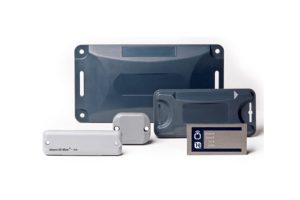
Also referred to as semi-passive or semi-active tags, Battery-Assisted Passive (BAP) RFID tags are essentially passive RFID tags with a built-in battery. Since these tags wait for a signal from an RFID reader before responding, they function similarly to active transponder tags.
When a BAP tag receives an RF signal from an RFID reader, the internal battery is activated and powers the integrated circuit (IC). The IC then modulates the signal based on the tag’s stored information. It then backscatters, or returns the signal to the RFID reader within the reading zone.
By using a battery to power the signal transmission, these tags can achieve a much greater read range than traditional passive RFID tags, ideally up to about 100 meters. Because their range is longer than passive tags (but they are generally more expensive), yet shorter than active RFID tags (and usually cheaper than active tags), they are considered a “middle-tier” option for applications that require extended range.
In addition to extending read range, the built-in battery also enables support for integrated sensor functions. These sensors allow the tag to monitor temperature, humidity, and other specific parameters. For example, BAP tags with integrated sensor monitoring can be attached to food or other goods during transport to ensure that temperature remains within a predefined safe range.
Since BAP tags do not continuously broadcast signals, their lifespan is typically slightly longer than active tags—usually around five years. However, like active tags, there is no simple or cost-effective way to replace the battery; once it is depleted, the tag must be replaced. BAP tags are generally larger and more rugged, and because they contain a battery, their price typically ranges from $10 to $25 per tag.
If an application already uses second-generation passive RFID hardware but requires a longer read range than passive tags can provide, BAP RFID tags can meet this need. Unlike active RFID tags, BAP tags use the same Gen2 RFID hardware as passive RFID tags, allowing both types of tags to work together in the same application.
Applications
Although BAP tags are not widely available on the market, they can be used across many industries and applications. Asset management accounts for the majority of use cases, especially in large-scale industries such as logistics and manufacturing.
For example, the Air France–KLM Engineering & Maintenance division uses BAP RFID tags in logistics to reduce the cost of expensive components and packaging materials. With readers distributed across multiple buildings and trucks used for transportation, KLM is able to manage the flow of parts, ultimately reducing packaging costs by 50%. BAP RFID tags were chosen for this application because the large facility and transport vehicles required long read distances. Combined with a customized software solution, the BAP system delivered the desired results for KLM, eliminating manual processes and enabling a nearly hands-free and paperless logistics operation.
 Cykeo RFID IoT Solution Products R&D Manufacturer