Why Do RFID Handheld Reader Prices Vary So Widely?
RFID handheld readers are essential tools in warehousing, logistics, retail, and manufacturing industries. Their prices range from a few hundred to over a thousand US dollars. This variation is not random—it is the result of multiple factors involving hardware, software, and value-added services. This article explains the five core elements that influence the price of RFID handheld readers to help international buyers choose wisely and purchase rationally.
Reading Performance: Range and Frequency Affect Cost Directly
Reading range is one of the most critical concerns for buyers. In general:
Short-range (0.5–2 meters): Suitable for retail or library management; more affordable.
Medium-to-long range (3–10 meters): Ideal for warehousing and industrial applications; requires stronger antennas and chips, resulting in higher costs.
Additionally, readers that support multiple frequency bands (such as UHF, HF, and LF) offer broader compatibility but come with a higher price tag.
Operating System and Processing Power: Android Costs More Than Basic UI
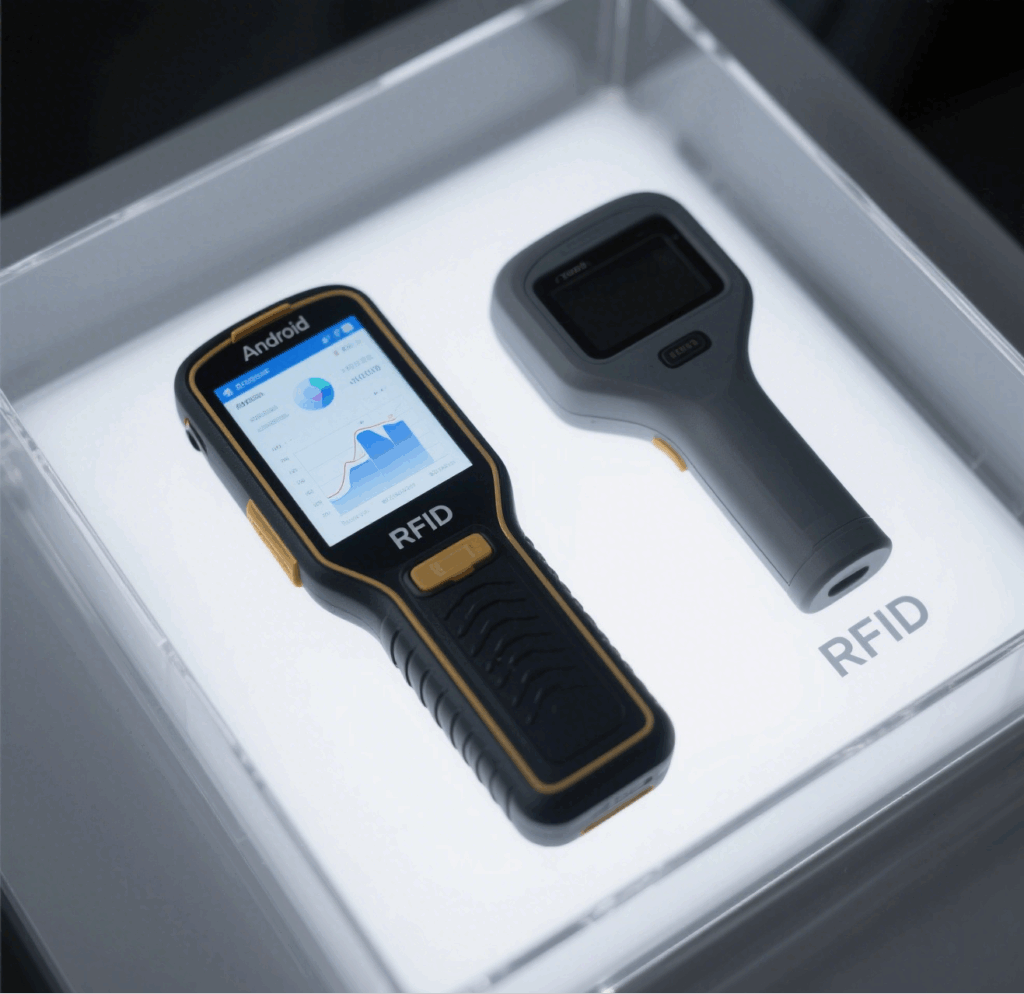
Modern RFID handheld terminals typically run Android OS, equipped with touchscreens to support WMS or ERP apps. However, higher configurations (e.g., octa-core processors, 4GB RAM, HD screens) significantly increase costs.
In contrast, basic models using Linux or custom firmware are more budget-friendly but offer limited functionality.
System Type
Functional Advantage
Price Comparison
Android
Highly extendable, app-friendly
🔺 Higher
Linux/Custom
Stable, cost-efficient
🔻 Lower
Durability and Industrial Protection: Higher IP Ratings Mean Higher Costs
RFID handheld readers used in industrial settings must withstand dust, water, and impact. Common protection levels include:
IP65/IP67 rating: Designed for outdoor warehouses and harsh environments, these models feature rugged waterproof and shockproof casings, making them more expensive.
Commercial-grade models: Offer basic dust and splash resistance; suitable for light-duty scenarios at a lower price.
Industrial-grade devices may also include high-capacity batteries (5000mAh+), low-temperature modules, and laser scanning heads, all of which contribute to higher pricing.
Additional Functions and Expansion Modules: More Features, Higher Costs
Many buyers look for multifunctional readers, such as:
Barcode scanner (1D/2D)
NFC reading/writing modules
Full connectivity (Bluetooth/4G/Wi-Fi)
GPS tracking
Camera and voice modules
These functions increase flexibility but also drive up costs. For example, an industrial RFID reader integrated with multiple modules can easily exceed $800–$1000.
Conclusion
Although RFID handheld reader prices can vary significantly, buyers should not focus solely on cost. Instead, they should consider application scenarios, performance needs, and after-sales service. Recommendations for buyers include:
Clearly define usage requirements and budget
Choose manufacturers with export experience and certifications
Request sample units to test reading stability and software compatibility
By making informed selections and building long-term supplier partnerships, buyers can fully leverage the benefits of RFID handheld readers in warehousing, traceability, and logistics management.
Cykeo’s CYKEO-T1D industrial RFID ceiling reader features 500 tags/sec scanning, IP54 protection, and -20℃~60℃ operation for retail/warehouse security. Supports ISO18000-6C and GB/T29768 protocols.
Cykeo’s ceiling-mounted RFID reader enables hands-free 5m inventory tracking with 500 tags/min speed. Features dual alerts, ERP integration, and IP54 rating for warehouse security.
Cykeo CK-T1E RFID gate system features 120° coverage, AI motion filtering, and 5m detection for retail/warehouse security. IP67 rugged design with ERP integration.
Discover how RFID smart linen cabinets like Cykeo CK-G2224 help hospitals automate linen tracking, reduce waste, improve infection control, and save staff time.
Learning how to use USB RFID reader? Step-by-step guide for Windows and Android. Plug-and-play setup, driver installation, software connection, and fixing common issues. Real advice from CYKEO engineers.
Wondering "can RFID sensors read through aluminum"? Discover how aluminum blocks RFID signals, why metal causes interference, and solutions for tracking assets in metal-rich environments with CYKEO.
 Cykeo RFID IoT Solution Products R&D Manufacturer