 Cykeo RFID IoT Solution Products R&D Manufacturer
Are there waterproof handheld RFID readers designed for outdoor use?
958Discover the best waterproof handheld RFID readers for outdoor use. Compare IP ratings, durability, and UHF performance for construction, agriculture, and logistics.
MoreAll RFID Product
A uhf rfid chip enables long-range, high-speed identification by powering RFID communication between tags and readers, typically achieving up to 10 meters read distance with rapid multi-tag processing.
That’s the clean answer.
But in actual deployments, the chip determines whether your system feels instant—or frustratingly inconsistent.
At the center of every UHF RFID system is the reader chip—commonly based on architectures like Impinj R2000.
With ceiling-mounted integrated devices (like Cykeo designs), this chip isn’t just a component—it defines system behavior.
In a warehouse ceiling installation (~8m height), switching to an R2000-based reader:
Not perfect—but predictable. That matters more.
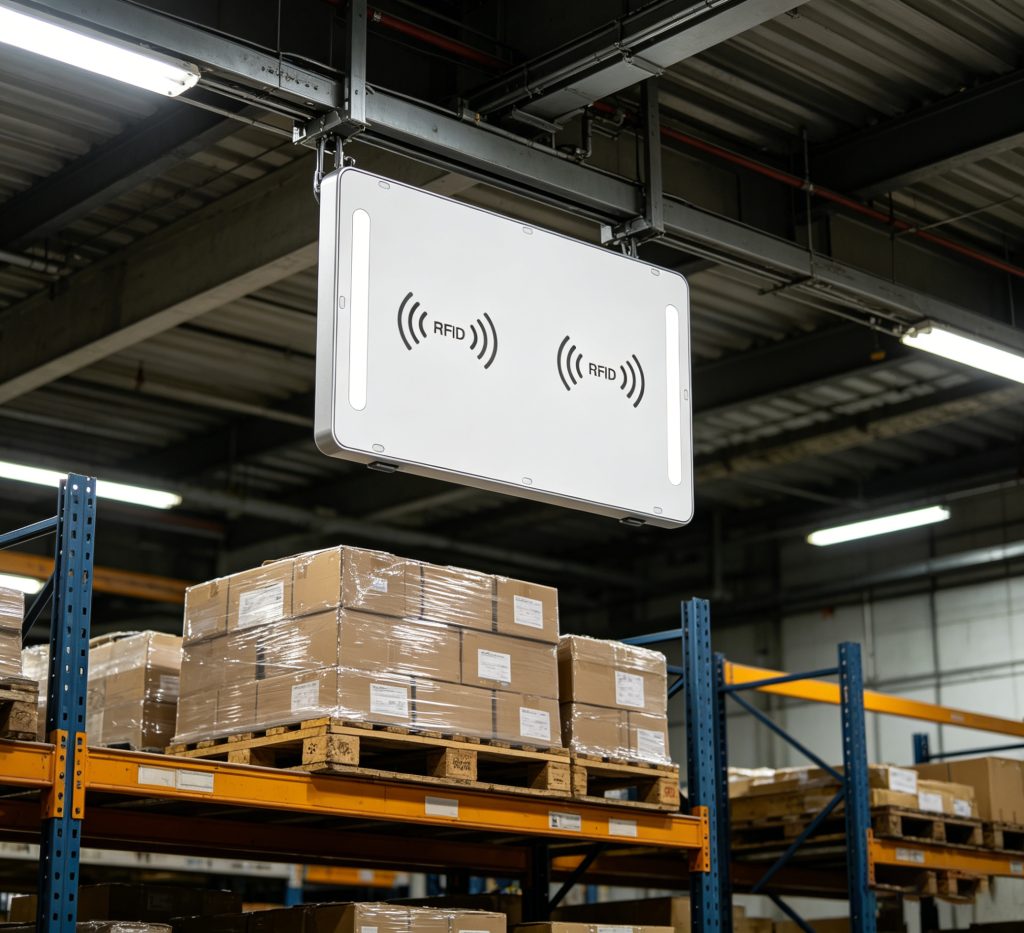
The Impinj R2000 chip remains one of the most widely deployed UHF RFID reader chips globally.
| Metric | R2000-based Systems |
|---|---|
| Read distance | Up to 10 meters |
| Tag processing | 400+ tags/sec |
| Sensitivity | High (dense environments) |
| Stability | Industrial-grade |
According to RAIN RFID Alliance:
Without a capable chip, antenna design alone won’t deliver results.
Ceiling-mounted UHF RFID systems change how tracking works.
No handheld scanning. No manual triggers.
With integrated antenna + reader chip:
In a retail exit scenario, the system didn’t react to shelves behind the gate—only moving tagged items triggered alerts. That filtering is chip-level intelligence, not just software.

It’s easy to confuse tag chips with reader chips.
| Type | Role |
|---|---|
| Tag chip | Stores ID (passive) |
| Reader chip | Controls communication |
The reader chip is the brain.
In dense tag environments (hundreds of items), weak chips fail first—not antennas.
Even high-end chips face constraints.
Most “chip failures” are environmental mismatches.
| Feature | UHF RFID Chip | HF RFID | LF RFID |
|---|---|---|---|
| Range | Long (10m) | Short | Very short |
| Speed | High | Moderate | Low |
| Multi-tag | Yes | Limited | No |
| Use case | Logistics, retail | NFC payments | Access control |
It enables long-range communication between RFID readers and tags, supporting fast multi-item identification.
Typically up to 10 meters depending on antenna design and environment.
Yes, it remains widely used due to stable performance and strong multi-tag processing capability.
A uhf rfid chip is easy to overlook.
It sits inside the reader. No interface. No branding.
But when it’s underpowered, everything slows down—missed reads, repeated scans, operator frustration.
When it’s right, the system disappears.
Things just move—and get recorded.
That’s usually how you know the chip is doing its job.

Discover the best waterproof handheld RFID readers for outdoor use. Compare IP ratings, durability, and UHF performance for construction, agriculture, and logistics.
More
Discover how does a RFID reader work. We explain the simple radio wave conversation between readers and tags that powers modern tracking & inventory.
More
How fast can RFID tags be read? Learn practical RFID read rates, multi-tag performance, reader factors, and warehouse conditions that determine real-world scanning speed.
More
How far away can RFID chips be read? Learn practical RFID ranges by frequency, reader power, antenna design, tag orientation, materials, and real-world conditions.
More