Walk into almost any server room, construction site, telecom cabinet, or event staging warehouse, and you’ll probably see the same thing.
Cables everywhere.
Some are neatly organized.
Many aren’t.
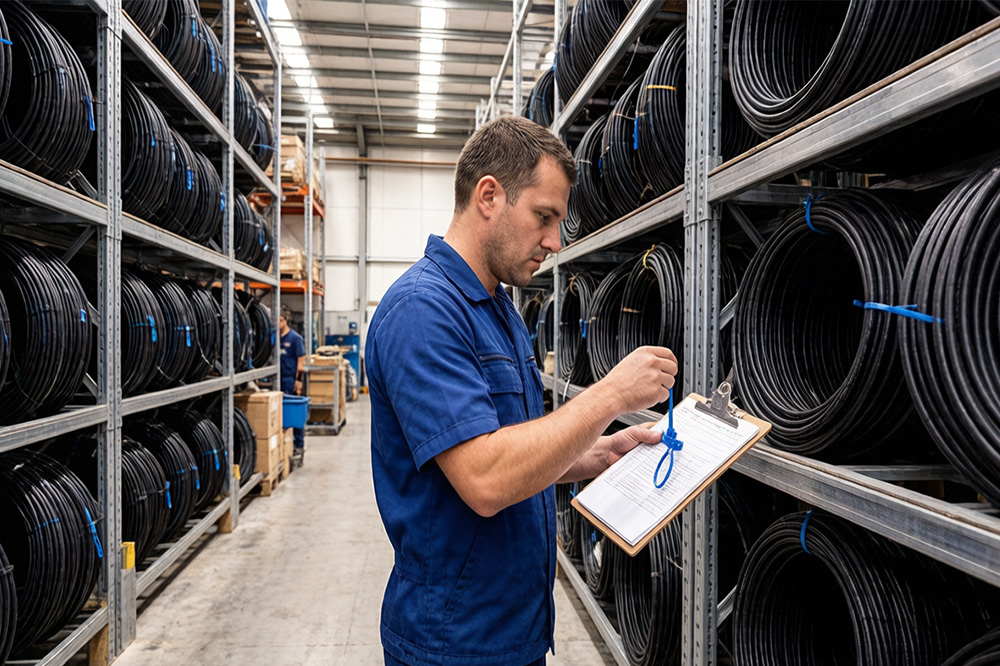
A few years ago, I visited a warehouse that handled audiovisual equipment rentals. The shelves looked organized from a distance. Hundreds of cables had been coiled and stored correctly. Yet when a large event order came in, the team still spent hours searching for specific cables.
Not because the cables were missing.
Because nobody knew exactly where they were.
That experience highlights something interesting.
In many operations, cables are among the most frequently handled assets, yet they’re often among the least visible.
Think about what happens after a concert, trade show, or corporate event.
Thousands of feet of cable come back to the warehouse.
Everything looks similar.
The pressure to prepare for the next event is immediate.
Without reliable tracking, inventory errors become common.
Wrong cables get shipped.
Missing equipment goes unnoticed.
Manual audits consume valuable labor.
RFID changes that process dramatically.
Multiple tagged cables can be identified quickly during receiving, packing, and inventory verification.
The result isn’t just faster inventory counts.
It’s fewer mistakes.
What Makes RFID Cable Tags Different?
At first glance, many RFID cable tags look deceptively simple.
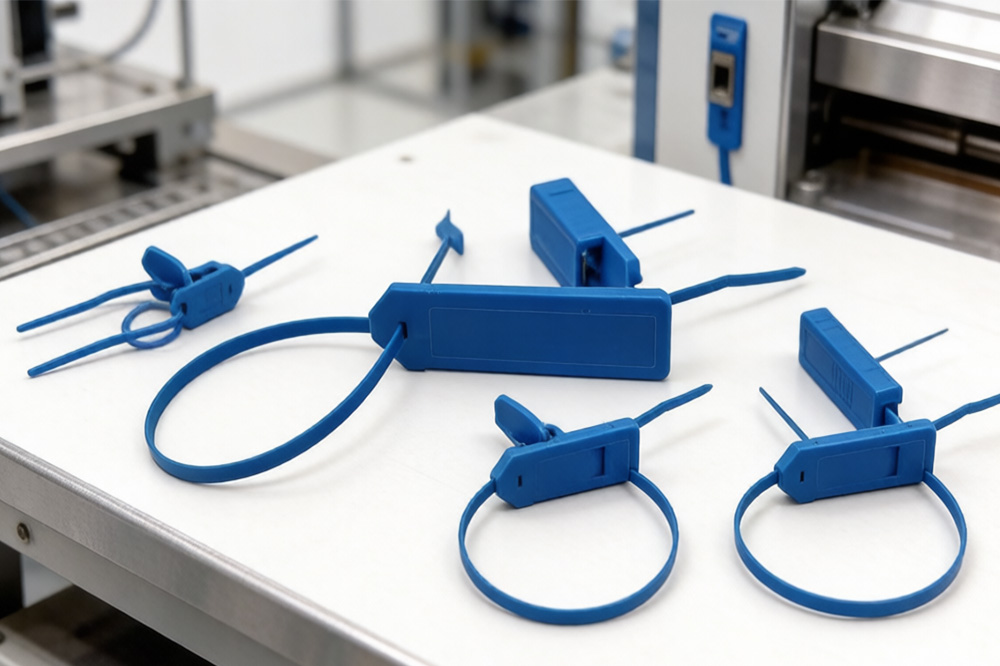
A small RFID component is integrated into a durable cable attachment structure.
Depending on the application, the tag may be:
Attached with a cable tie
Secured around a wire bundle
Embedded into a protective housing
Locked permanently onto an asset
Installed as a reusable identification marker
The design matters because cables experience constant movement and stress.
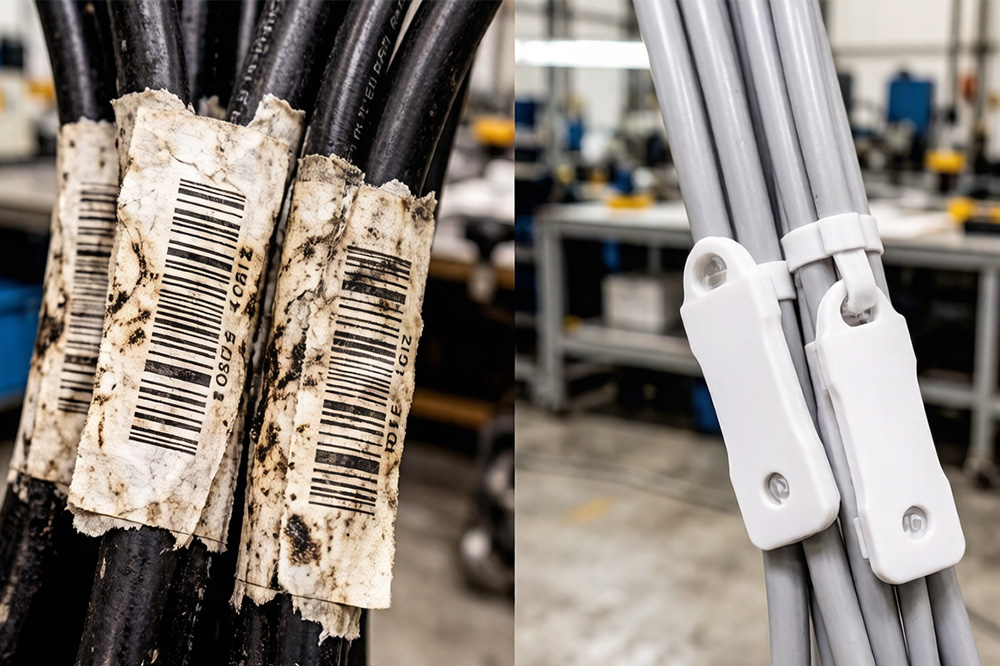
A standard RFID label that works well on a cardboard box might fail quickly when attached to a cable that’s repeatedly bent, pulled, and transported.
That’s why industrial cable tags are typically engineered for durability rather than appearance.
The Data Center Scenario Nobody Talks About
Data centers spend millions on infrastructure.
Yet cable identification is still surprisingly challenging.
Network upgrades happen constantly.
Equipment moves.
Connections change.
New racks get installed.
Old systems are retired.
Some facilities contain tens of thousands of individual cables.
When every cable looks nearly identical, mistakes become expensive.
A technician disconnecting the wrong cable can create far bigger problems than simply losing track of inventory.
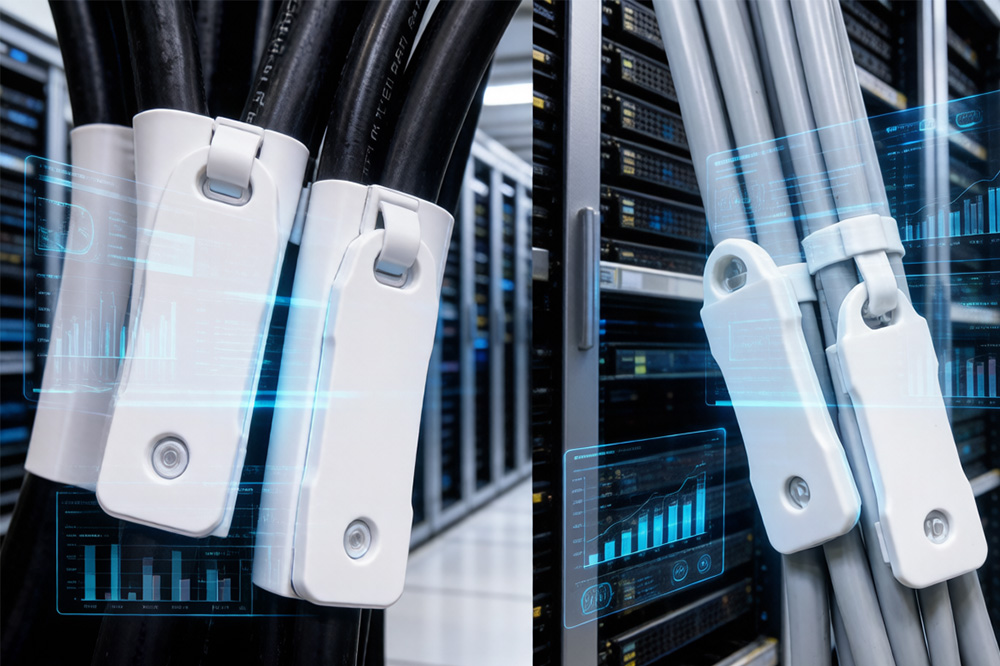
RFID cable tags add another layer of visibility.
Instead of relying entirely on visual inspection, organizations can integrate cable identification into broader asset management systems.
That becomes increasingly valuable as facilities grow.
Outdoor Environments Create Different Challenges
Indoor applications are relatively forgiving.
Outdoor environments are not.
Sunlight.
Rain.
Snow.
Extreme temperatures.
Chemical exposure.
Dust.
Vibration.
These conditions can quickly destroy ordinary identification labels.
That’s why many RFID cable tags are designed using rugged materials capable of surviving harsh industrial environments.
In utility networks, telecommunications infrastructure, and construction projects, durability often becomes more important than tag cost.
Replacing failed labels repeatedly ends up costing more than investing in a solution designed to last.
Cable Management Isn’t Really About Cables
This might sound strange, but the biggest benefit of RFID cable tags often has nothing to do with cables.
It’s about information.
Managers want answers.
Where is the cable?
When was it last used?
Who checked it out?
Has it been returned?
Is it scheduled for maintenance?
How many identical assets are currently available?
Without reliable identification, those questions become difficult to answer.
RFID transforms a physical cable into a traceable asset.
That’s where the real value appears.
A Growing Trend in Asset Tracking Projects
Something I’ve noticed over the past few years is that cable tags increasingly appear inside larger RFID deployments.
A company starts by tracking tools.
Then equipment.
Then containers.
Eventually someone realizes cables are still creating blind spots.
That’s often when RFID cable tags get added to the system.
Instead of managing cables separately, organizations bring them into the same asset visibility platform.
The result is a more complete picture of operations.
Not perfect.
But significantly better than relying on spreadsheets and manual counts.
Choosing the Right RFID Cable Tag
The best RFID cable tag depends heavily on the environment.
Questions worth asking include:
Will the cable be used indoors or outdoors?
Is the tag intended to be permanent or removable?
What reading distance is required?
How frequently will the asset be handled?
Will the cable be exposed to chemicals or moisture?
Does the application require bulk inventory scanning?
Different projects lead to different answers.
A telecommunications network has very different requirements from an event rental company.
That’s why one-size-fits-all solutions rarely perform equally well across every industry.
When Bulk Identification Changes the Workflow
One of RFID’s biggest advantages isn’t locating a single cable.
It’s identifying many cables at once.
Imagine receiving hundreds of returned cables after a large project.
Instead of checking each item individually, staff can rapidly verify inventory using RFID technology.
That changes labor requirements.
It changes inventory accuracy.
And in many cases, it changes how quickly equipment can be redeployed.
For organizations managing thousands of assets, those efficiencies become difficult to ignore.
Looking Beyond Labels
The conversation around RFID cable tags often starts with identification.
But the more interesting discussion is visibility.
Businesses rarely lose money because a cable is expensive.
They lose money because they don’t know where the cable is, whether it’s available, or whether it’s already been assigned elsewhere.
The cable itself may only cost a few dollars.
The downtime created by missing information can cost much more.
That’s why industries ranging from telecommunications and utilities to audiovisual rental and data center management continue adopting RFID cable tracking solutions.
Not because the tag is complicated.
Because operations become simpler when every cable can tell its own story.
Recommended Product
For projects requiring durable cable identification and asset tracking, explore our:RFID Cable Tags
Whether you’re managing hundreds of cables or hundreds of thousands, the ability to identify assets quickly and accurately often starts with a tag that’s small enough to overlook—but powerful enough to change the entire workflow.
CYKEO Passive RFID Tags are made for wet and high-humidity environments where standard labels do not last. This rfid passive tag is often used around liquids, chemicals and temperature changes, providing stable reading distance and long data life for industrial tracking.
CYKEO CYKEO-PCB1504 Metal RFID Tags is a compact anti-metal UHF RFID solution built for direct mounting on metal surfaces. With stable 8-meter read range, Ucode-8 chip, and long data retention, this rfid metal tag fits tools, containers, automotive parts, and industrial asset tracking.
CYKEO CYKEO-PCB7020 On-Metal RFID Tags are designed for reliable tracking on steel and metal surfaces. Built with an FR4 epoxy body and industrial-grade chips, these On-Metal RFID Tags deliver stable performance, long data life, and chemical resistance, making them a dependable RFID anti-metal tag for harsh environments.
The CYKEO CYKEO-60-25 Anti-Metal RFID Tag is built for metal surfaces where standard tags fail. Designed for long-range performance, harsh environments, and stable data retention, this Anti-Metal RFID Tag is ideal for industrial assets, containers, and equipment tracking using on metal RFID tags.
The CYKEO RFID Laundry Tag is designed for long-term textile identification in harsh laundry environments. Built to withstand high heat, chemicals, and repeated washing, this RFID Laundry Tag delivers stable performance for hotels, hospitals, and industrial laundry operations using laundry rfid tags at scale.
The CYKEO CYKEO-125-7 RFID Book Tag is designed for reliable book and document tracking in libraries and archives. This RFID Book Tag delivers long read range, dense placement support, and stable performance on shelves, making it a practical rfid tag on books for library automation, file management, and archival systems.
CYKEO RFID tags in hospitals are designed for sterile environments where accuracy matters. These autoclavable RFID tags support long-term tracking of surgical tools, implants, and medications, helping hospitals improve visibility, compliance, and patient safety.
CYKEO RFID Cable Tie Tag is built for reliable identification on metal surfaces. This UHF RFID Cable Tie Tag is widely used in rfid tags for inventory systems, industrial asset management and Hospital RFID Tags, offering stable read performance, long service life and global EPC Gen2 compatibility.
CYKEO RFID Asset Tag is designed for stable identification of metal assets in industrial environments. This UHF RFID Asset Tag is commonly used for rfid tag asset tracking on equipment, tools and containers, providing reliable reads, long service life and ISO/IEC 18000-6C support.
CYKEO UHF RFID Card is designed for fast identification and long-term use in industrial and commercial systems. Supporting ISO 18000-6C, this UHF RFID Card works at 860–960 MHz and is suitable for custom RFID cards used in asset tracking, access control and inventory management.
CYKEO HF RFID Cards are designed for secure and stable access control systems. These 13.56 MHz RFID key cards support ISO 14443-A, reliable rewriting and long service life, making HF RFID Cards suitable for offices, campuses, events and membership management.
CYKEO UHF RFID Tag is designed for reliable tracking of metal jewelry and high-value items. This Jewelry RFID Tag supports long-range reading up to 8 meters, anti-counterfeit protection and stable performance on metal, making it suitable for retail, inventory control and asset management.
RFID Industry Writer | IoT & Asset Tracking Analyst
James writes about RFID technology, asset tracking, and the practical challenges of digital transformation across warehousing, retail, manufacturing, and logistics.
His work focuses on how RFID is applied in real-world operations—improving inventory visibility, automating workflows, and helping businesses manage assets with greater accuracy and efficiency.
He regularly covers topics including UHF RFID, smart cabinets, RFID portals, tool tracking, warehouse automation, and industrial IoT trends..
Discover how handheld RFID readers optimize logistics tracking with mobile scanning, automated sorting, and cargo identification, enhancing supply chain visibility and operational efficiency.
Discover how RFID warehouse solutions slash errors and boost efficiency. Learn setup steps, real-world benefits, and Cykeo’s implementation best practices.
Discover the best handheld RFID readers for small business inventory management. Compare budget-friendly options, UHF performance, and software integration for retail, warehouses, and startups.
 Cykeo RFID IoT Solution Products R&D Manufacturer