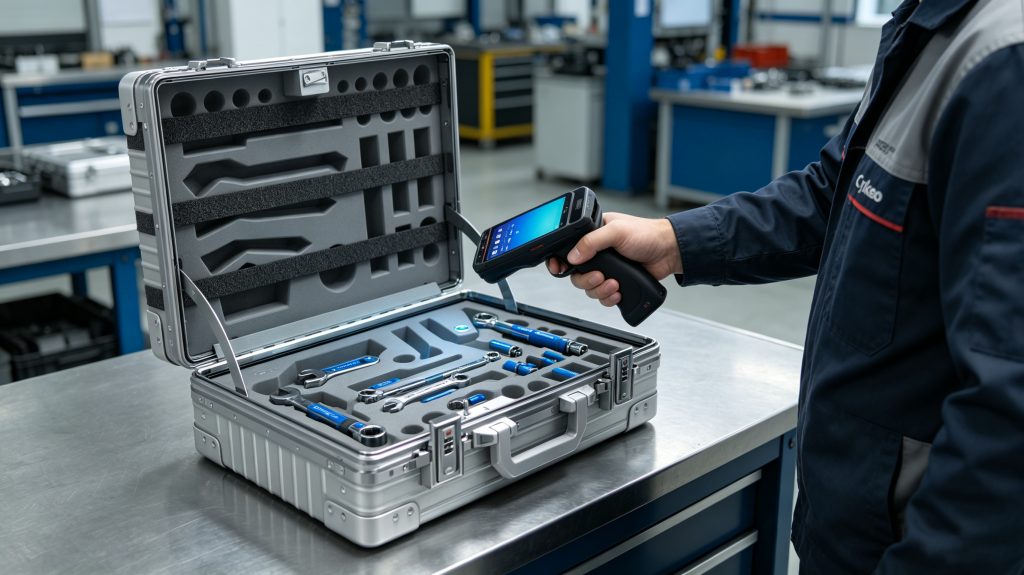
A passive rfid tag reader is an industrial device that energizes and reads passive RFID tags without requiring batteries in the tags. It enables fast, contactless identification of tools, assets, and equipment in environments such as workshops, warehouses, and field maintenance operations.
In Cykeo systems, it is commonly deployed in smart tool management and industrial inspection workflows, ensuring every tagged item is tracked in real time without manual scanning.
How passive RFID tag reading works in real workshops
A passive RFID system operates by transmitting radio frequency energy toward a tag. The tag reflects encoded data back to the reader.
Based on ISO/IEC 18000-6C (EPC Gen2) standards, widely used in industrial logistics systems , the process allows:
Simultaneous multi-tag reading
Non-line-of-sight detection
Real-time inventory updates
In field environments, such as railway maintenance or industrial tool rooms, this eliminates the need for manual checklist verification.
Real-time tool inventory verification using RFID scanning system
Why passive rfid tag reader is essential in industry
In real operations, manual tracking introduces errors that can affect safety and efficiency. A passive rfid tag reader solves this by automating identification.
Key operational problems it addresses:
Missing tools after field operations
Slow manual inventory checks
Human error in asset recording
Lack of real-time visibility
Industries relying heavily on this include:
Railway maintenance
Aviation repair
Power plant inspection
Industrial manufacturing logistics
Cykeo smart tool integration: CYKEO-B2 system
Cykeo integrates passive RFID reading into its CYKEO-B2 smart tool kit system, designed for high-risk field operations.
Core functions include:
One-click tool locking inside toolbox
Automatic exit inventory scanning
Real-time missing tool alarm
Bluetooth mobile configuration
This creates a closed-loop system where every tool is verified before leaving the workspace.
Technical structure of passive RFID tag reader systems
RF energy activation process
The reader emits RF signals that power passive tags momentarily, enabling them to return stored ID data.
System standards
Most industrial systems comply with:
ISO/IEC 18000-6C
EPCglobal Gen2 architecture
These ensure global compatibility across logistics systems and industrial deployments.
Field experience: real workshop observations
In real industrial environments, engineers often observe:
How to choose RFID solution for retail operations with smart checkout, RFID readers, self-service systems, and retail automation solutions for modern stores.
Learn how handheld RFID readers integrate with smartphones and tablets via Bluetooth, USB, or apps. Discover use cases for retail, logistics, and field service.
RFID readers can make retail inventory checks much faster by identifying multiple tagged products without requiring employees to scan every item individually...
 Cykeo RFID IoT Solution Products R&D Manufacturer