 Cykeo RFID IoT Solution Products R&D Manufacturer

what does a handheld rfid writer do
125A handheld RFID writer programs, updates, and verifies RFID tag data wirelessly, enabling mobile RFID management for assets, inventory, and field operations.
MoreAll RFID Product
Long range RFID scanner can automatically identify tagged products, containers, tools, and work-in-process items as they move through different production stations. The real benefit comes from combining the RFID reader with properly positioned antennas, RFID tags, sensors, PLCs, and manufacturing software.
Manufacturing plants usually have a simple problem that becomes surprisingly complicated at scale: where is this product right now?
A component may pass through machining, assembly, inspection, testing, packaging, and storage before it becomes a finished product. If every movement depends on manual barcode scanning, production data can quickly become incomplete.
This is where RFID manufacturing systems become useful.
A long range RFID scanner can identify products without requiring an operator to stop and scan each item individually. When the reader, antenna, RFID tag, and production software are configured correctly, the system can automatically record that a product has entered or left a particular production station.
But there is an important point here: RFID does not automatically understand the manufacturing process. The reader detects the RFID tag. The software decides what that detection means.
That distinction matters when designing a production line.
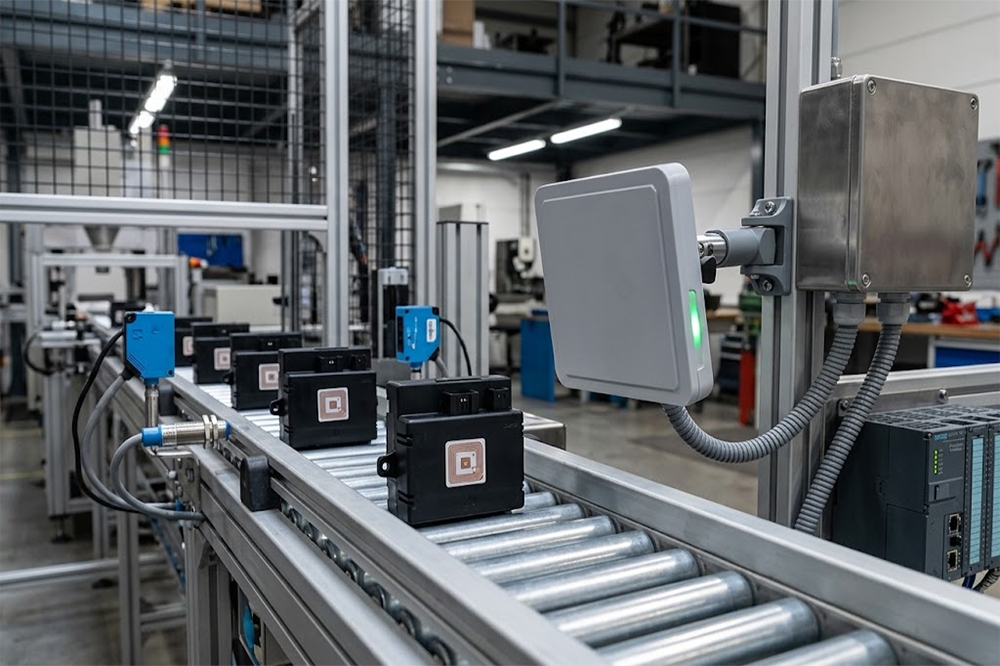
The basic process is quite straightforward:
RFID tag → reading zone → RFID reader → EPC data → production software → manufacturing event
For example, imagine a metal component moving from Station 2 to Station 3.
The component has RFID tag with a unique EPC number. When it enters the RFID reading area, the long range RFID scanner detects the tag.
The system can then associate that EPC with a product record:
The next time the same tag appears at another station, the software updates the production history.
This creates a digital trail for the work-in-process item.
Work-in-process, or WIP, is one of the areas where RFID can make a noticeable difference.
In a busy factory, unfinished products often sit in carts, bins, trays, racks, or temporary storage areas. A worker may know where something is physically, but the production system may not know.
Barcode systems can work well, but they usually require the code to face the scanner.
RFID doesn’t need the same line-of-sight operation.
A worker can move a cart containing multiple tagged items through an RFID reading zone, and the reader may identify several tags during the same event.
Of course, “may” is important.
If the tags are stacked tightly together, mounted against metal, or surrounded by materials that absorb RF energy, the result can be very different from a clean laboratory test.
I’ve seen production applications where the reader itself wasn’t the problem. The tag location was.
When a production line has reading problems, increasing reader power is usually the first idea people have.
It isn’t always the best one.
A manufacturing RFID system needs a controlled reading zone, not simply the largest possible reading distance.
Suppose a product needs to be detected only when it reaches Station 4. If the reader can detect that product several meters before Station 4, the software may receive the event too early.
That creates another problem: the RFID system may know the tag is nearby, but not exactly where the manufacturing process expects it to be.
Antenna placement helps control this.
Depending on the product and conveyor design, antennas can be installed:
For some applications, two antennas facing the product from different directions provide much better reliability than one antenna operating at higher power.
RFID tags should not simply be stuck onto the product wherever there is space.
In manufacturing, the product may contain:
These materials can affect RFID performance.
For metal products, an on-metal RFID tag may be necessary.
For plastic products, a standard UHF RFID label might work perfectly well.
For a production tray containing several components, the tag may need to be placed on the outside of the tray rather than between the products.
This is why I would recommend testing the actual product before choosing the final RFID tag.
A tag that works beautifully on a sample carton may perform poorly once the same tag is attached to a finished metal assembly.
Production speed is another detail that is easy to overlook.
Imagine a product moving slowly through an RFID reading zone. The reader has plenty of time to detect the tag.
Now increase the conveyor speed.
The product spends less time inside the effective reading area. If the tag orientation is poor or the reading zone is too small, missed reads may start appearing.
This doesn’t mean every high-speed production line needs an expensive reader.
It means the RFID system needs to be tested at the actual production speed.
A useful test normally includes:
If the system works only when the conveyor is running slowly, it isn’t ready for production.
A production RFID reader usually works as part of a larger automation system.
The RFID reader identifies the tag. A sensor can tell the system that a product has physically arrived. A PLC can control the machine. Production software can record the event.
For example:
Photoelectric sensor detects product → PLC triggers RFID reading → reader identifies EPC → software checks product record → production station starts
This approach can make the RFID reading process much more controlled.
Depending on the reader model, communication may include Ethernet, TCP/IP, serial communication, digital I/O, HTTP, MQTT, API, or SDK interfaces.
The exact interface matters when an RFID system integrator needs to connect the reader to existing factory equipment.
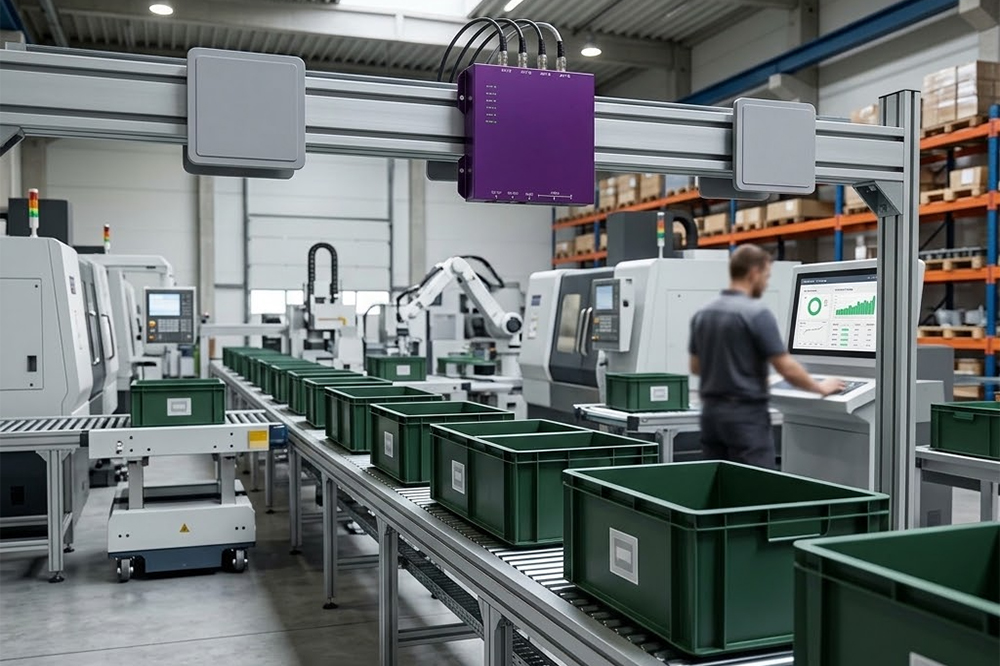
Manufacturing environments rarely move products one at a time.
A tray might contain ten components.
A cart might carry thirty.
Several tagged containers may pass through the same reading zone within a few seconds.
UHF RFID is useful here because the reader can identify multiple tags in the same RF field.
But the software still needs to determine what those reads mean.
For example, if ten components are expected at Station 5 and only nine EPCs are detected, the system can flag a missing item.
That is much more useful than simply displaying ten EPC numbers on a screen.
The manufacturing application needs to turn RFID reads into meaningful production events.
Consider an electronics factory assembling a product in several stages.
At the first station, a reusable production tray receives an RFID tag.
The tray moves to assembly.
A fixed RFID reader detects the tray at the assembly entrance and records the start time.
After assembly, the tray moves to testing. Another RFID scanner records the arrival.
If the product fails testing, the production system can associate the failure with that specific tray or product ID.
Later, when the same item reaches packaging, another RFID reading confirms the next production stage.
Instead of asking workers to scan a barcode at every point, the factory creates an automatic movement history.
The RFID reader doesn’t replace the manufacturing software. It provides the identification data that the software needs.
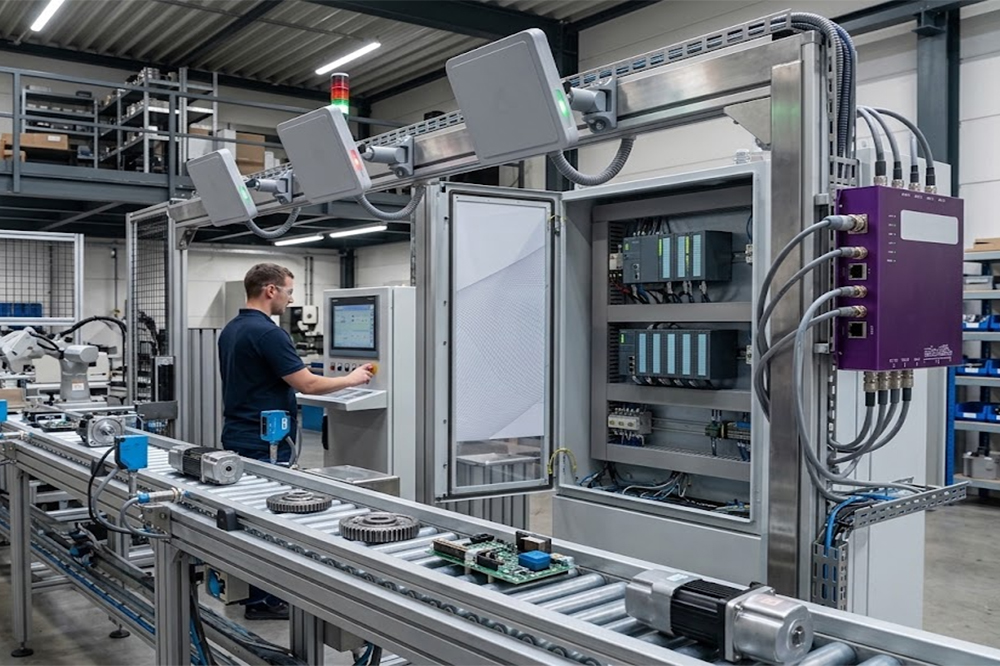
For manufacturing applications, a 20-meter reading range isn’t necessarily better than a 5-meter range.
Actually, a huge reading zone can make the system harder to control.
If the production process requires precise station identification, you usually want the RFID reader to detect the tag where the event happens, not everywhere around the machine.
This is one reason a long range RFID scanner should be selected based on the application rather than the maximum number printed in a product specification.
Reader sensitivity, antenna gain, antenna direction, tag performance, product material, installation height, and RF environment all affect the actual result.
Before recommending a reader for a manufacturing project, I would test at least these conditions:
Don’t test only one successful pass.
Run the product through the reading zone dozens or hundreds of times.
A system that gives excellent results in five tests may behave differently after a longer production run.
For RFID distributors and solution providers, hardware specifications are only part of the purchasing decision.
Check the reader’s:
It is also useful to ask whether the supplier can provide matching antennas, RFID tags, cables, and development support.
A distributor that can supply the complete RFID package has a much easier time supporting system integrators.
RFID manufacturing projects are rarely identical.
A reader that works well on a conveyor application may not be the best choice for a machining line, assembly workstation, or automated storage area.
The safest approach is simple: test the real application first.
Use the actual product, actual RFID tag, actual antenna position, and realistic production speed.
Once the reading performance is stable, the system can move toward software integration and bulk procurement.
For factories, this reduces deployment risk. For RFID distributors and system integrators, it also makes product selection much easier.
The long range RFID scanner is an important part of the system, but it is only one part. The best production-line results usually come from matching the reader, antenna, tag, installation, PLC, and software around the actual manufacturing process.
Yes. A fixed UHF RFID reader can automatically identify tagged products as they pass through a defined reading zone. The RFID data can then be connected with manufacturing software to record production events, station movements, or WIP status.
Yes, but the RFID tag needs to be selected carefully. Standard RFID labels may perform poorly when attached directly to metal. On-metal UHF RFID tags are often a better option for metal components, tools, equipment, and containers.
Yes. UHF RFID readers can identify multiple tags within their reading zone. However, tag density, product spacing, tag orientation, antenna position, and software filtering all affect the actual performance.
Many industrial RFID readers provide interfaces that can support PLC and automation integration, such as Ethernet, TCP/IP, serial communication, digital I/O, APIs, or SDKs. The exact interfaces should be checked against the customer’s PLC and control architecture.
Definitely. Testing should use the actual product, RFID tag, mounting position, antenna configuration, production speed, and environmental conditions. This gives a much more realistic indication of production performance than a laboratory reading-distance test.
RFID Industry Writer | IoT & Asset Tracking Analyst
James writes about RFID technology, asset tracking, and the practical challenges of digital transformation across warehousing, retail, manufacturing, and logistics.
His work focuses on how RFID is applied in real-world operations—improving inventory visibility, automating workflows, and helping businesses manage assets with greater accuracy and efficiency.
He regularly covers topics including UHF RFID, smart cabinets, RFID portals, tool tracking, warehouse automation, and industrial IoT trends..
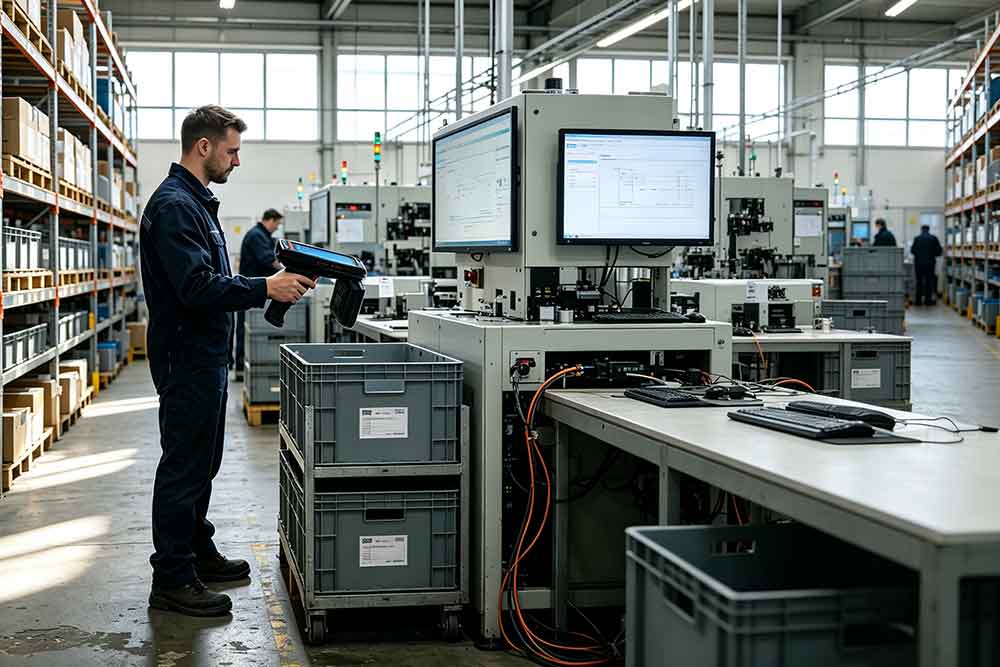
A handheld RFID writer programs, updates, and verifies RFID tag data wirelessly, enabling mobile RFID management for assets, inventory, and field operations.
More
Learn how RFID tool tracking works — from tag selection and reader setup to real-world workflows and troubleshooting. A complete guide for factories, workshops, and field service teams to regain control of tool management.
More
RFID location tracking gives real-time visibility of assets and people. Learn how CYKEO delivers accurate tracking in real environments.
More
Discover how RFID being used on pets improves identification, feeding control, anti-swapping security, and veterinary registration beyond simple tracking.
More