Logistics RFID enables automatic identification and real-time tracking of goods, pallets, containers, and assets throughout the supply chain. By eliminating manual scanning, RFID significantly improves inventory accuracy, warehouse efficiency, and shipment visibility while reducing operational costs.
Walk into a busy distribution center during peak season and one thing becomes immediately obvious: speed alone doesn’t keep freight moving—visibility does. Over the past decade, I’ve worked alongside warehouse operators, logistics integrators, and manufacturing teams implementing RFID systems across Europe and Asia. The projects that delivered the greatest return weren’t necessarily the ones with the most readers. They were the ones where every pallet, every returnable container, and every outbound shipment could be identified automatically without interrupting workflow. That’s where logistics RFID proves its value every day.
What Is Logistics RFID?
Logistics RFID refers to the application of Radio Frequency Identification technology throughout warehousing, transportation, inventory management, and supply chain operations.
Unlike barcode systems that require direct line-of-sight scanning, RFID identifies multiple tagged items simultaneously and automatically.
Typical logistics RFID components include:
UHF RFID tags
Fixed RFID readers
Handheld RFID readers
RFID antennas
Warehouse management software (WMS)
Enterprise resource planning (ERP) integration
Cloud-based tracking platforms
Together, these components create a continuous flow of operational data without slowing warehouse processes.
Why Has Logistics RFID Become Essential?
Distribution centers process thousands of items every day.
Manual barcode scanning introduces delays, especially when cartons are stacked on pallets or loaded inside trailers.
RFID changes that workflow entirely.
Instead of scanning one package at a time, RFID captures dozens—or even hundreds—of tagged items automatically as they pass through an RFID portal.
The operational benefits include:
RFID Capability
Business Value
Automatic pallet identification
Faster receiving and shipping
Multi-tag reading
Higher operational efficiency
Real-time inventory visibility
Better stock accuracy
Automated shipment verification
Fewer shipping errors
Contactless identification
Reduced labor requirements
Continuous asset monitoring
Improved traceability
One retail distribution customer reduced outbound verification time dramatically after replacing manual barcode checkpoints with fixed RFID portals. The improvement came not from working faster, but from eliminating repetitive scanning altogether.
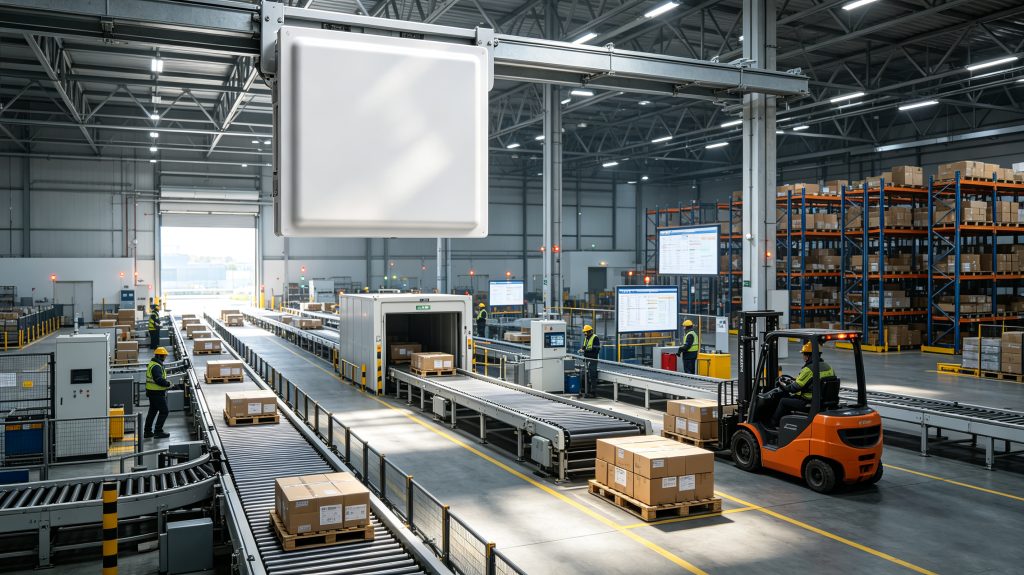
Cykeo logistics RFID solution enables automatic pallet identification in a modern distribution center.
Where Is Logistics RFID Used?
Although warehouse management remains the largest application, RFID now supports nearly every stage of the supply chain.
Warehouse Management
Automatically records inbound receiving, storage movements, inventory counting, and outbound shipping.
Transportation & Distribution
Tracks pallets, reusable containers, trailers, and shipping assets in real time.
Manufacturing Logistics
Monitors raw materials, work-in-progress inventory, and finished products moving between production areas.
Retail Distribution
Improves store replenishment by increasing shipment accuracy and reducing receiving time.
Cold Chain Logistics
Provides continuous identification of temperature-sensitive products moving through refrigerated supply chains.
Key Features of a High-Performance Logistics RFID System
The most successful deployments rely on more than long reading distance.
Based on our field experience, several characteristics consistently determine project success.
Industrial-Grade Reliability
Readers must operate continuously in dusty warehouses, loading docks, and outdoor logistics yards.
Advanced Anti-Collision Algorithms
Large shipments often contain hundreds of RFID tags.
Efficient anti-collision processing ensures rapid identification without missed reads.
Flexible Communication Interfaces
Industrial RFID readers should support:
Ethernet (TCP/IP)
RS-232
RS-485
GPIO
REST API or middleware integration
Software Development Support
Cykeo provides:
SDK
API
DEMO software
Technical documentation
These resources enable seamless integration with WMS, ERP, MES, and third-party logistics platforms.
Industry Data Supporting Logistics RFID
Independent organizations continue to document the rapid growth of RFID across global supply chains.
According to GS1, RFID implementations can achieve inventory accuracy of 99% or higher when deployed using standardized identification practices, significantly improving inventory visibility and reducing manual counting errors.
The RAIN Alliance reports that billions of passive UHF RFID tags are deployed worldwide each year across logistics, retail, manufacturing, healthcare, aviation, and industrial automation, reflecting the widespread adoption of RFID technology.
These findings closely match the performance improvements our engineering team observes during customer deployments.
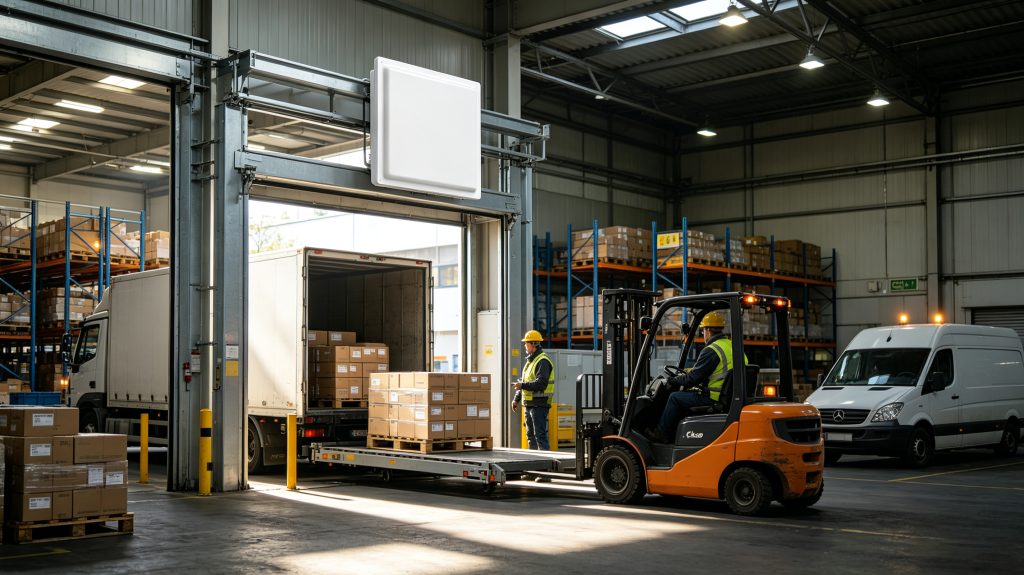
Cykeo RFID portal automatically records outbound logistics without manual barcode scanning.
Field Experience from Cykeo Engineers
A project for an automotive parts supplier illustrates an important lesson.
The customer initially wanted the highest possible reader power.
During testing, however, excessive RF coverage began identifying pallets in adjacent loading bays.
Instead of increasing power further, we narrowed the antenna reading zone and adjusted the installation angle.
Reading accuracy improved immediately.
The experience reinforced something we often explain during site surveys:
A well-designed RFID reading zone is more valuable than the longest possible reading distance.
At Cykeo, RF site testing is part of every logistics deployment because warehouse environments rarely behave exactly like laboratory conditions.
Frequently Asked Questions
What is the main advantage of logistics RFID over barcode systems?
RFID identifies multiple tagged items simultaneously without requiring line-of-sight scanning, significantly increasing warehouse efficiency.
Can logistics RFID integrate with warehouse management systems?
Yes. Cykeo RFID solutions support integration with WMS, ERP, MES, and other enterprise software through SDKs and APIs.
Is logistics RFID suitable for outdoor logistics yards?
Yes. Industrial-grade RFID readers are designed for demanding indoor and outdoor environments with reliable long-term performance.
Which industries benefit most from logistics RFID?
Warehousing, retail distribution, manufacturing, third-party logistics (3PL), automotive, pharmaceuticals, cold chain logistics, and e-commerce fulfillment all benefit from RFID automation.
Conclusion
Logistics RFID has become a cornerstone of modern warehouse and supply chain automation. By enabling real-time identification, automated shipment verification, and accurate inventory visibility, RFID eliminates many of the inefficiencies associated with manual processes. Combined with industrial-grade hardware, intelligent anti-collision algorithms, and seamless software integration, Cykeo logistics RFID solutions help organizations build faster, more transparent, and more resilient supply chains.
Learn how RFID solution providers and integrators build scalable apparel inventory systems. From garment RFID tags to reader and antenna layouts, optimize retail and warehouse tracking with reliable RFID solutions.
handheld uhf rfid reader devices improve inventory accuracy, warehouse tracking, and industrial asset visibility with Cykeo ultra high frequency RFID technology.
RFID technology is revolutionizing medical equipment and asset management. This article explores RFID applications in the healthcare industry, highlighting benefits, real-world use cases, and future trends to help hospitals reduce costs and improv...
Passive RFID tags work by harvesting RF energy from a reader, powering their IC, and returning data through modulated backscatter without using an internal b...
 Cykeo RFID IoT Solution Products R&D Manufacturer