 Cykeo RFID IoT Solution Products R&D Manufacturer
Can NFC Read RFID? Making Sense of the Alphabet Soup.
338Confused by the terms? We answer "can NFC read RFID" by clarifying how these technologies relate and what this means for real-world applications.
MoreAll RFID Product
To reprogram an RFID tag, place it within a controlled read zone, scan its existing data, then overwrite memory using a compatible reader and software. Stable power output, correct protocol, and short-range positioning ensure high rewrite success and prevent unintended tag interference.
Reprogramming isn’t “editing a file.” It’s rewriting memory banks under strict RF conditions.
In practice, with a device like Cykeo D1L desktop encoder, the process feels simple—but underneath, timing, signal strength, and anti-collision all matter. <h3>Typical rewrite sequence</h3>
Miss step 6, and you’re guessing.
| Parameter | Real-world effect |
|---|---|
| 33 dBm output | Ensures stable data overwrite |
| ≤30 cm read range | Avoids unintended tag detection |
| ≤10 cm write range | Improves single-tag precision |
| Near-field antenna | Reduces signal reflection errors |
According to RAIN RFID Alliance , dense tag environments can reduce encoding accuracy by 20–35% without proper anti-collision handling. In my own deployment tests, uncontrolled range caused more issues than insufficient power.
It’s rarely the tag.
More often:
One textile client I worked with saw 11% rewrite failure during peak hours. After switching to near-field encoding and enabling tag filtering, the failure rate dropped below 1%—no hardware upgrade, just controlled workflow.
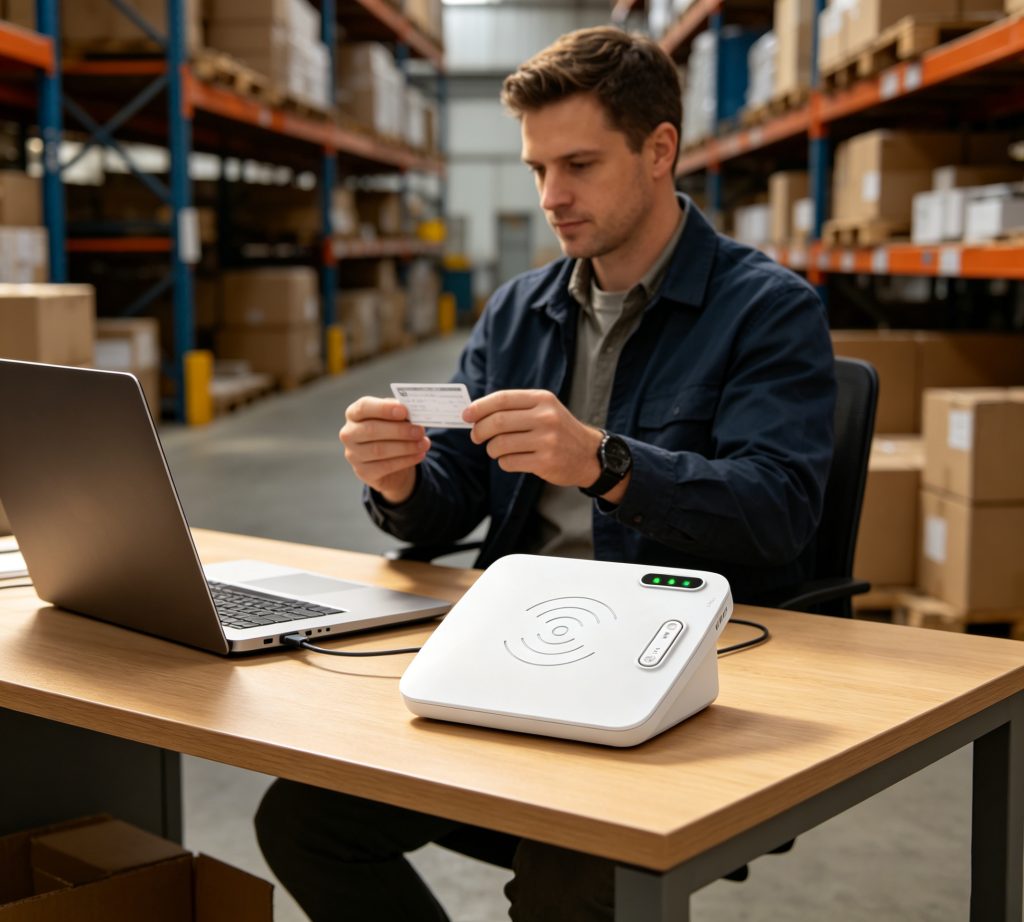
Here’s the trade-off most teams don’t talk about.
Multi-tag detection – Faster throughput – Higher collision risk
Single-tag rewrite – RSSI filtering enabled – Immediate verification
A GS1 EPCglobal deployment report (epcglobalinc.org) highlights that verification-based encoding workflows improve data reliability by over 30% in supply chain environments.
From a software standpoint, reprogramming is just an API call. But reliability depends on structure.
With Cykeo SDK (C# / Java):
One small habit I recommend: log both RSSI + write result. That combination helps diagnose 90% of field issues later.

No. Some tags are locked or designed as read-only. Check memory lock status before attempting.
Typically EPC and USER memory. TID is usually factory-locked.
Because multiple tags are within range. Use near-field control and filtering.
Most tags support thousands of write cycles depending on chip quality.
Understanding how to reprogram rfid tag is less about commands and more about control.
Distance. Timing. Verification.
Ignore any one of these, and accuracy drops quietly—until it becomes a problem.
The best setups aren’t the fastest.
They’re the ones that don’t need a second attempt.
Confused by the terms? We answer "can NFC read RFID" by clarifying how these technologies relate and what this means for real-world applications.
More
Wondering "can you read 2 RFID tags next to each other"? Discover how RFID anti-collision works, tag spacing requirements, and solutions for reliable multi-tag reading with CYKEO.
More
A field-based look at RFID cross reading problems in warehouse gate systems. Why misreads happen, how directional RFID antennas help control read zones, and why installation often matters more than replacing hardware.
More
Discover the maximum read range for industrial UHF RFID tags with handheld scanners. Learn how tag type, environment, and antenna design impact performance.
More