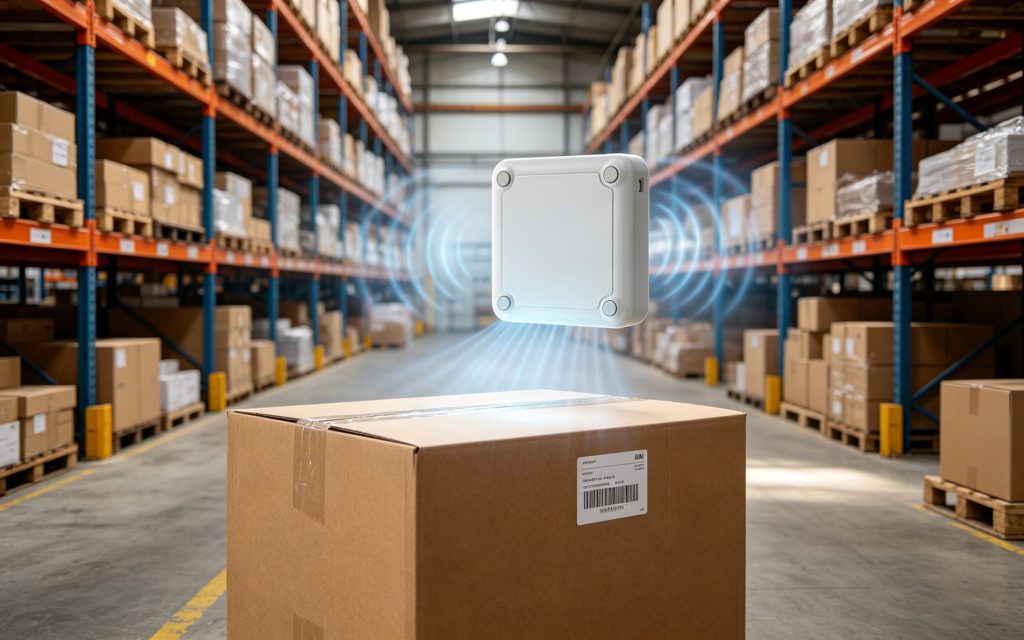
RFID works without a battery by using the reader’s radio waves to power passive tags, which harvest this energy and reflect a modulated signal back to transmit data instantly and wirelessly.
That’s the mechanism in one line. But when you stand near a conveyor line watching hundreds of tags respond—without a single battery—it starts to feel less like “wireless” and more like controlled physics.
passive RFID working principle in real conditions
Energy harvesting, not storage
Passive RFID tags don’t store energy—they borrow it.
When a reader emits RF signals:
The tag antenna captures electromagnetic energy
The chip rectifies it into usable DC power
The chip activates briefly (microseconds)
Data is sent back via backscatter
No battery. No charging cycle. Just instant activation.
According to GS1 EPCglobal standards, passive RFID systems can operate reliably with microwatt-level power harvested from RF fields—orders of magnitude lower than even the smallest battery-powered devices.
how backscatter actually sends data
The subtle part most explanations skip
The tag doesn’t “transmit” in the traditional sense.
Instead, it:
Switches its antenna impedance
Reflects the reader’s signal in patterns
Encodes binary data in those reflections
Think of it as a mirror that flickers in a controlled rhythm.
From field measurements:
Parameter
Typical Value
Activation power
~10–100 µW
Response time
<5 ms
Read rate
>400 tags/sec
This is why passive RFID scales so well—no onboard energy bottleneck.
Passive RFID tags activate instantly using RF energy from reader
real-world performance vs theoretical limits
Distance depends on physics, not just specs
In theory, UHF passive RFID can reach 10–15 meters.
In practice:
Cardboard + air → near max range
Liquids → signal absorption
Metal → reflection and dead zones
A field test in a distribution center showed:
14 m read distance (ideal alignment)
9–11 m average operational range
~30% drop when tags were misaligned
This aligns with data from RAIN RFID Alliance, which reports significant performance variation based on environment and tag placement.
why battery-free RFID dominates industry
Cost, scale, and maintenance
Passive RFID wins not because it’s “simpler,” but because it’s scalable:
No battery replacement
Tag lifespan: 10+ years
Cost per tag: often <$0.10 in volume
Unlimited read cycles (practically speaking)
Compare that to active RFID:
Feature
Passive RFID
Active RFID
Power
Reader-powered
Battery
Cost
Low
High
Maintenance
None
Battery replacement
Range
Short–medium
Long
In large deployments (millions of tags), battery-free is the only viable option.
The customer raised the problems and requirements for RFID Gate Reader products. We listen to the customer's answers about the environment in which the product is used. Give each other all opinions to each other about the project situation and ex...
CYKEO CK-B4L is a compact RFID Card Reader Android, designed for developers building Android systems and apps. RFID Reader for Android App Connect via Type-C to enable fast, stable RFID tag reading for anti-counterfeiting, inspection, picking, an...
Looking for a long range RFID scanner for warehouse, logistics, manufacturing, or asset tracking? Learn key factors including reading distance, antenna design, frequency, integration, and OEM options before bulk purchasing.
Learn how to connect RFID reader to SQL database. Our guide covers data flow architecture, deduplication strategies, and reliable integration using CYKEO tools.
 Cykeo RFID IoT Solution Products R&D Manufacturer