 Cykeo RFID IoT Solution Products R&D Manufacturer
What is the Use of an RFID Tag in a Car?
895Discover how RFID tags enhance automotive security, streamline maintenance, and improve user experiences. Explore Cykeo’s RFID solutions for modern vehicles.
MoreAll RFID Product
RFID retail security tags combined with a handheld rfid writer enable real-time item tracking and anti-theft control, significantly reducing shrinkage and improving inventory accuracy in retail stores.
That’s the direct answer. On the shop floor, though, it feels less like “technology” and more like fewer blind spots—especially during peak hours when manual checks quietly fail.
Author: Cykeo Smart Retail RFID Team
In one apparel chain rollout (~28 stores), RFID retail security tags were introduced alongside handheld encoding devices:
Shrinkage is rarely dramatic—it accumulates quietly. RFID interrupts that pattern.
RFID retail security tags are smart labels or hard tags embedded with RFID chips. Unlike traditional EAS tags, they:
According to NRF (National Retail Federation) , global retail shrink reached $112.1 billion in 2022, highlighting the scale of loss prevention challenges.
A handheld rfid writer is used to encode RFID retail security tags with product-specific data:
This can happen:
The difference is subtle but critical—stores gain autonomy instead of waiting for pre-tagged inventory.
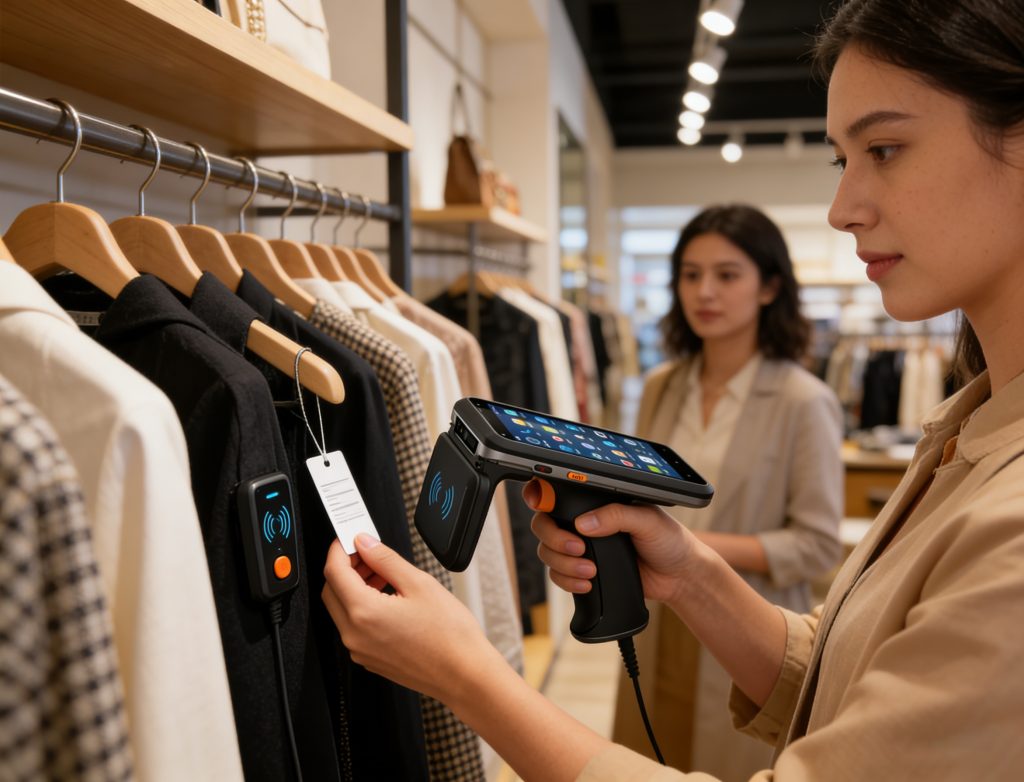
RFID retail security tags create traceable movement:
Unlike EAS, RFID doesn’t just alarm—it informs.
Manual inventory checks are inconsistent. RFID changes that.
According to GS1 , RFID systems can deliver inventory accuracy above 95%, enabling better replenishment decisions.
In practice, weekly counts often become daily spot checks.
| Feature | RFID Security Tags | Traditional EAS Tags |
|---|---|---|
| Data storage | Yes | No |
| Inventory tracking | Real-time | Not supported |
| Anti-theft capability | Yes | Yes |
| Operational insight | High | Low |
| Integration with systems | Strong | Limited |
In real stores, RFID retail security tags don’t eliminate theft entirely—but they change behavior.
Staff become more proactive. Inventory gaps are detected earlier. And perhaps most importantly, decision-making shifts from assumption to data.
One store manager described it simply:
“Before RFID, we guessed. Now we verify.”
In many cases, yes. RFID can combine inventory tracking and anti-theft functions, reducing the need for separate systems.
Yes. This is especially useful for small retailers or mixed inventory sources.
Hard tags are often reusable, while RFID labels are typically single-use.
RFID retail security tags don’t just protect inventory—they reshape store operations.
When paired with a handheld rfid writer, tagging becomes flexible, data becomes immediate, and losses become visible earlier than before.
And in retail, earlier visibility is everything.

Discover how RFID tags enhance automotive security, streamline maintenance, and improve user experiences. Explore Cykeo’s RFID solutions for modern vehicles.
More
Discover the top software tools to program RFID tags, including encoding, data management, and integration solutions. Learn how Cykeo simplifies RFID development.
More
RFID toll gate systems have become vital tools for digitalized traffic management.
More
RFID barrier gates are becoming a common sight in parking lots, residential communities, and workplaces. Here’s a closer look at how they work, why they matter, and what it’s like to actually use them in daily life.
More