Industrial asset tracking RFID systems use ultra high frequency (UHF) RFID tags and readers to identify, locate, and manage industrial equipment in real time with high accuracy and low manual labor.
In large factories, the real problem is rarely “missing inventory.” It is usually delayed maintenance, misplaced tools, duplicated purchasing, or production downtime caused by assets sitting in the wrong zone. I first saw this clearly during a warehouse deployment in Southeast Asia where technicians spent nearly 40 minutes locating calibrated torque tools before each shift. After deploying a Cykeo UHF RFID solution, search time dropped to under 5 minutes within two weeks.
That difference changes operations fast.
Why industrial asset tracking RFID is growing so quickly
Industrial RFID adoption is accelerating because barcode systems cannot efficiently track thousands of moving assets across production floors, repair stations, and warehouses.
According to research from Deloitte, unplanned downtime costs industrial manufacturers billions annually, with some facilities losing up to $50 billion globally due to equipment failures and operational inefficiencies.
Meanwhile, RFID adoption continues rising across logistics and industrial environments because UHF RFID can scan multiple tags simultaneously without line-of-sight requirements.
A 2024 report from RFID Journal noted that industrial UHF RFID deployments commonly improve inventory accuracy above 95%.
What makes UHF RFID different in industrial environments
The biggest advantage is reading speed under harsh conditions.
Traditional barcode workflows slow down when:
Equipment surfaces are dusty
Labels are scratched
Assets move continuously
Operators wear gloves
Inventory areas are congested
Cykeo industrial asset tracking RFID systems solve this by using:
Feature
Operational Benefit
UHF RFID identification
Long-distance bulk reading
Anti-collision algorithms
Multiple tags scanned simultaneously
RSSI signal detection
Asset proximity awareness
EPC Gen2 compatibility
Cross-platform deployment
Metal-resistant tag options
Stable industrial performance
On one automotive tooling project, we tested manual barcode scanning versus fixed UHF RFID tunnel scanning. Barcode verification averaged 3.7 seconds per item. RFID handled entire carts instantly while forklifts continued moving.
No stop. No rescan.
That operational rhythm matters more than marketing brochures usually admit.
Where industrial asset tracking RFID performs best
Manufacturing plants
Factories use industrial asset tracking RFID to monitor:
Torque tools
Calibration devices
Production fixtures
Reusable containers
Maintenance equipment
Real-time visibility reduces tool loss and improves maintenance scheduling.
Warehouse and logistics centers
UHF RFID enables automatic movement tracking between:
Receiving areas
Picking zones
Repair stations
Dispatch docks
The reduction in manual inventory counting is often dramatic.
According to Auburn University RFID Lab studies, RFID-based inventory systems can significantly outperform barcode-only inventory processes in retail and industrial environments.
Energy and utility operations
Industrial assets in power facilities often move across outdoor environments where visual labels fail quickly.
RFID tags survive:
Oil exposure
Dust
Humidity
Abrasion
Temperature fluctuation
This is where industrial-grade UHF tags outperform paper labels almost immediately.
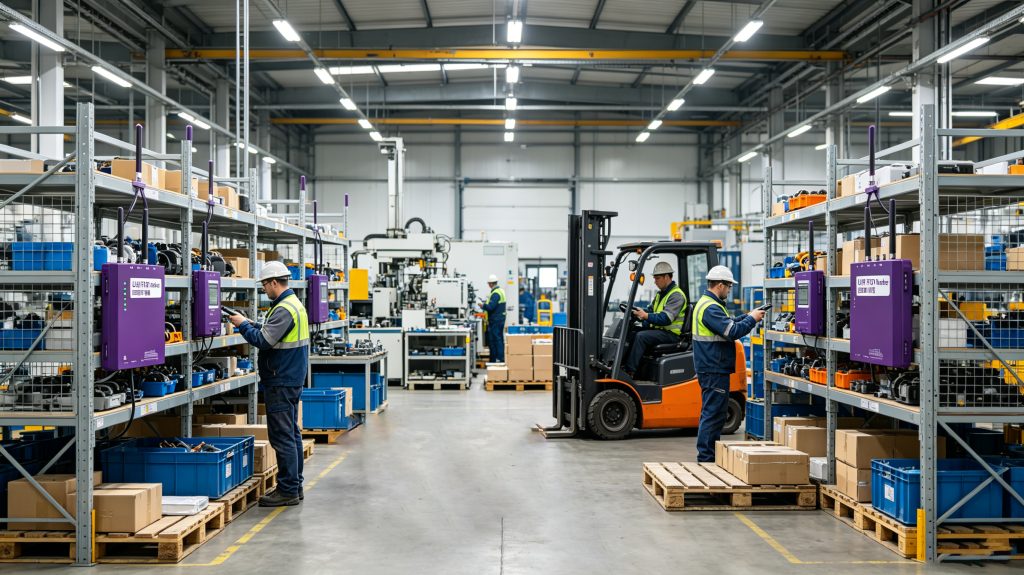
Cykeo UHF RFID technology enables real-time industrial equipment visibility across manufacturing operations.
Cykeo industrial asset tracking RFID deployment experience
At Cykeo, we typically recommend near-field and long-range UHF combinations depending on workflow density.
One lesson learned repeatedly: reader placement matters more than raw transmit power.
A poorly positioned antenna at 33dBm still produces blind zones. A correctly angled antenna at lower output often performs better.
That only becomes obvious after real installation work.
How industrial asset tracking RFID reduces operational waste
The hidden cost in manufacturing is not always lost equipment. It is uncertainty.
Operators begin keeping duplicate tools “just in case.” Departments reorder assets because nobody trusts inventory records. Maintenance teams delay inspections because locating equipment takes too long.
RFID changes behavior because visibility becomes continuous instead of occasional.
Typical improvements include:
Faster audit cycles
Reduced manual counting
Lower replacement purchasing
Better maintenance traceability
Improved asset utilization
In several deployments, clients discovered they owned significantly more spare equipment than ERP systems showed.
That happens surprisingly often.
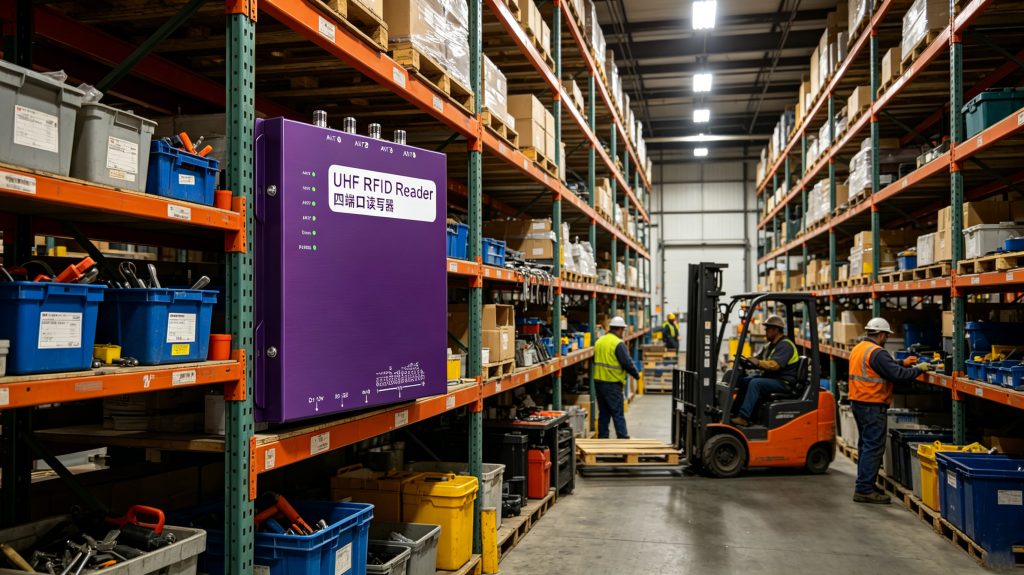
Cykeo RFID infrastructure improves warehouse inventory visibility and operational efficiency.
FAQ about industrial asset tracking RFID
What frequency is best for industrial asset tracking RFID?
Ultra high frequency (UHF) RFID is generally best because it supports long-range reading, bulk scanning, and fast inventory processing in industrial environments.
Can RFID tags work on metal equipment?
Yes. Industrial on-metal RFID tags are specifically designed for metallic surfaces and maintain stable read performance in harsh environments.
How accurate is industrial RFID tracking?
Well-designed UHF RFID systems commonly achieve inventory accuracy above 95%, depending on tag placement and reader configuration.
Is RFID better than barcode tracking?
For industrial asset visibility, RFID is usually more efficient because it does not require direct line-of-sight scanning and supports simultaneous multi-tag reading.
Conclusion
Industrial asset tracking RFID is no longer limited to large enterprise automation projects. With modern UHF RFID infrastructure, manufacturers can achieve faster inventory visibility, reduced downtime, and more reliable equipment management without slowing operations.
Cykeo continues developing industrial RFID solutions focused on stable high-density reading, durable UHF tag performance, and real-world deployment reliability across manufacturing and warehouse environments.
RFID Industry Writer | IoT & Asset Tracking Analyst
James writes about RFID technology, asset tracking, and the practical challenges of digital transformation across warehousing, retail, manufacturing, and logistics.
His work focuses on how RFID is applied in real-world operations—improving inventory visibility, automating workflows, and helping businesses manage assets with greater accuracy and efficiency.
He regularly covers topics including UHF RFID, smart cabinets, RFID portals, tool tracking, warehouse automation, and industrial IoT trends..
Learn how to choose the right antenna for a long range RFID scanner. Understand UHF RFID antenna types, reading distance, polarization, installation tips, and supplier selection for industrial RFID projects.
Discover how RFID modules optimize EV battery recycling—tracking health, ensuring compliance, and reducing costs. Learn Cykeo’s solutions for sustainable battery management.
A practical look at how integrators deploy networked RFID key cabinets across multiple sites, including connectivity, system monitoring, and lessons from real projects.
 Cykeo RFID IoT Solution Products R&D Manufacturer