Can an RFID Antenna Activate Devices? The Truth About Wireless Power
We get this question a lot from engineers and product designers: “Can an RFID antenna activate devices?” It usually comes with a hopeful idea—maybe powering a small LED, waking up a sensor, or triggering a latch without batteries. The short, honest answer is: not in the way you’re probably imagining. An RFID antenna isn’t a wireless charger for your phone or a universal remote. But, it can “activate” something very specific under the right conditions, and understanding this distinction is key to designing a successful system.
What It Actually Means to “Activate” in RFID Terms
Let’s reframe the thought. In the RFID world, “activation” doesn’t mean booting up a complex electronic device with a microcontroller, display, and motor. What a UHF RFID antenna transmits is Radio Frequency (RF) energy, and not a huge amount of it due to strict regulatory limits.
What this RF energy can do is provide just enough power to a tiny, ultra-low-power microchip—the silicon die inside an RFID tag. This is the core principle of passive RFID sensor power. The antenna’s transmitted wave energizes the tag’s chip, which then uses that harvested energy to run its simple logic, retrieve data from its memory, and modulate the backscatter signal to reply with its ID. This is the only “device” a standard RFID antenna is designed to activate: a passive RFID tag chip.
The Power Gap: Why It Can’t Run Your Gadget
The expectation gap comes from confusing RFID vs wireless power technology. Dedicated wireless charging systems (like Qi chargers) are engineered for one job: transferring usable wattage over very short distances. They use tightly coupled magnetic induction and sophisticated control circuits.
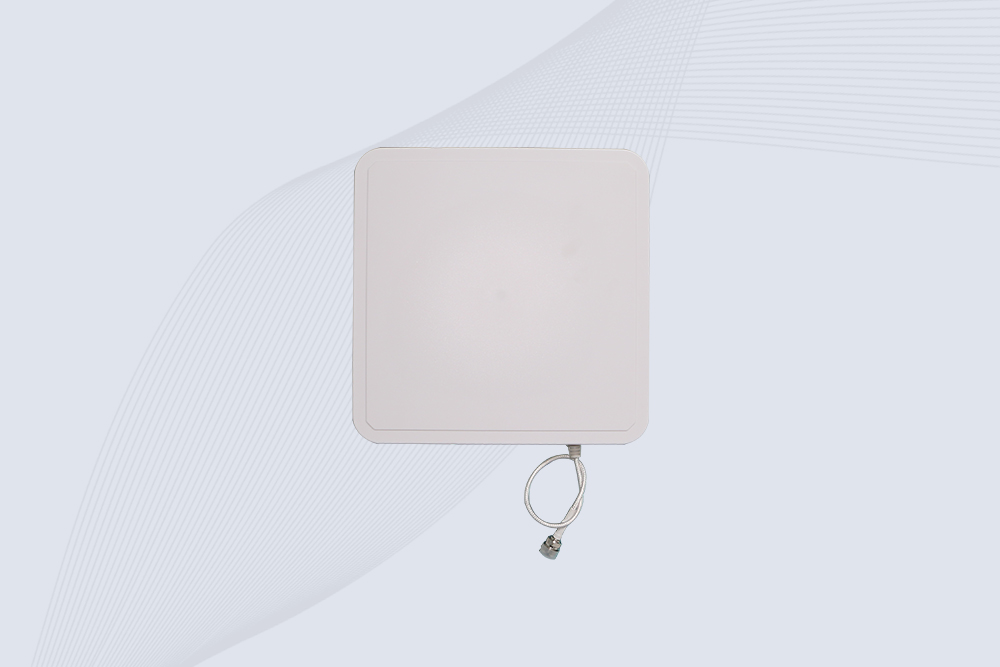
A standard UHF RFID reader antenna, by contrast, is designed for communication over meters, not power transfer. It broadcasts energy in all directions (or a broad beam), and most of it dissipates into space. The fraction that reaches a small tag antenna is measured in microwatts or milliwatts—barely enough to blink an LED for a split second, and nowhere near enough to run a conventional electronic device, even a small one.
So for the question “can an RFID antenna activate devices” like a motor, a buzzer, or a Bluetooth module, the practical answer is no. The available power is orders of magnitude too low.
The Exception: When “Activation” is Possible
This is where it gets interesting for innovators. If you redefine your “device” to be something with near-zero power consumption, rfid antenna power device activation scenarios emerge. We see this in cutting-edge applications:
- Battery-Assisted Passive (BAP) Sensors: Here, the RFID antenna doesn’t power the sensor itself. Instead, it acts as a precise, proximity-based wake-up signal. A BAP tag has a tiny battery to run its sensor (e.g., for temperature), but keeps its radio in a deep sleep to save years of battery life. The reader’s RF signal is detected, waking the radio to transmit its logged data. The antenna “activates” the communication, not the sensing.
- Simple Electro-Mechanical Triggers: In research labs, you might see an antenna powering a custom, single-purpose circuit that, after accumulating enough RF energy over several seconds, discharges to release a mechanical latch or change an LCD pixel. It’s slow, finicky, and highly tailored.
- Enhanced Passive Sensor Tags: The most relevant commercial application. Specialized passive tags have sensors integrated directly into the RFID chip (for temperature, moisture, etc.). The reader antenna does activate and power both the chip and its embedded sensor for just long enough to take a reading and send it back—all wirelessly. This is the frontier of what’s reliably possible.
So, What Should You Do?
If you’re exploring short-range wireless activation methods, start with a clear power budget. How many milliwatts does your “device” need, and for how long?
- If you need to send data or a unique ID: Use standard passive UHF RFID. It’s perfect.
- If you need to read a condition (temp, humidity): Look at those enhanced passive sensor tags or BAP tags.
- If you need to trigger an action requiring real power: Consider an RFID system coupled with a separate mechanism. For example, a passive tag is read, the reader sends a signal to a controller, and that controller activates the device. The RFID antenna is the identification trigger, not the power source.
At CYKEO, we help clients navigate these choices. The magic isn’t in asking “can an RFID antenna activate devices?” in a general sense. It’s in precisely defining what “activate” means for your project and then engineering the simplest, most robust system—which often involves RFID as the smart, wireless trigger within a broader solution.
RFID Antenna Recommendation
 Cykeo RFID IoT Solution Products R&D Manufacturer