 Cykeo RFID IoT Solution Products R&D Manufacturer

RFID Reader Security: Protecting Your Data from Cyber Threats
770Learn how to secure RFID readers from cyber threats and protect sensitive data. Discover Cykeo’s best practices for RFID cybersecurity in 2024.
MoreAll RFID Product
A few months ago, someone sent us a short email.
“We need your strongest RFID antenna.”
There wasn’t much else in the message.
No project description.
No warehouse layout.
No information about the tags or readers.
Just one sentence.
At first glance, it sounds reasonable. If a stronger antenna reads farther, then it must be the better choice.
But after working on enough RFID projects, I’ve learned that’s usually not how things play out.
Sometimes the antenna with the highest gain creates more problems than it solves.
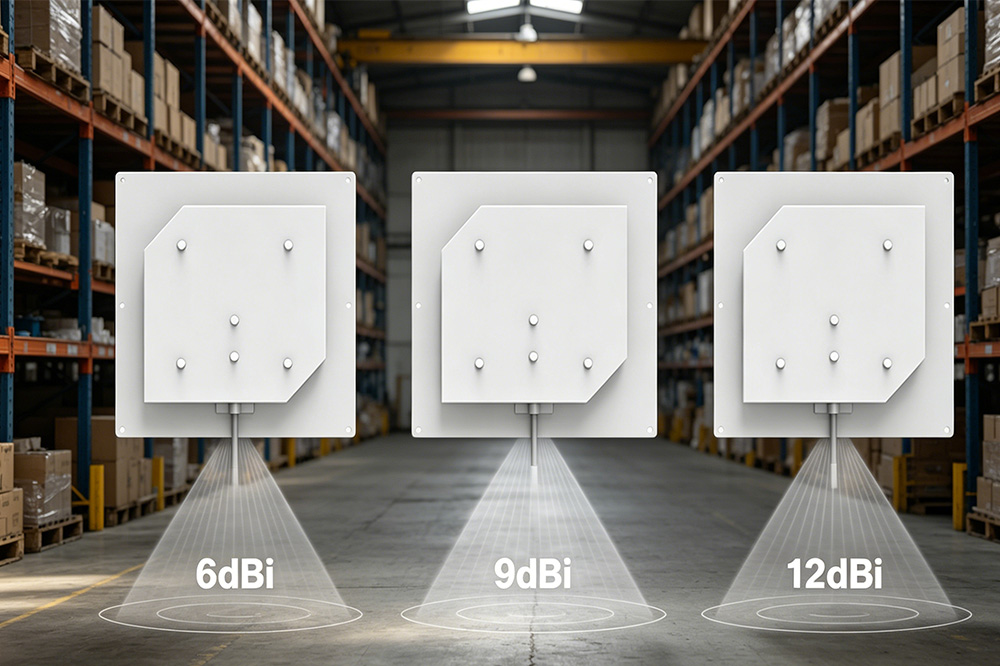
When buyers compare RFID antennas, the first specification they usually notice is gain.
6dBi.
9dBi.
12dBi.
It’s tempting to think the larger number automatically means better performance.
In reality, gain simply describes how concentrated the antenna’s energy is.
A 12dBi antenna doesn’t magically create more power.
It focuses the available energy into a narrower pattern.
That can extend reading distance.
It can also reduce coverage where you actually need it.
Choosing an antenna is a little like choosing a flashlight.
A spotlight reaches farther.
A floodlight covers more area.
Neither is “better” until you know where you’re pointing it.
After visiting different warehouses and production sites, certain patterns appear again and again.
A 6dBi antenna normally provides a wider reading area.
It works well when tags approach from different angles or when coverage is more important than maximum distance.
Typical applications include:
The trade-off is obvious.
Reading distance is generally shorter than higher-gain models.
But sometimes that’s exactly what a project needs.
If someone asked me to recommend one antenna without telling me much about the project, I’d probably start with 9dBi.
Not because it’s perfect.
Because it’s flexible.
It offers a practical balance between coverage and distance.
That’s one reason it’s commonly seen in:
Many integrators treat it as a reliable starting point before making site-specific adjustments.
A 12dBi antenna is designed for more focused coverage.
The beam becomes narrower.
Reading distance can increase.
However, alignment also becomes more important.
If tagged objects don’t pass through the intended area, performance may actually become less consistent.
These antennas are often selected for:
Higher gain doesn’t necessarily mean easier deployment.
Sometimes it means tighter installation tolerances.
Another specification buyers often overlook is beam width.
You’ll commonly see values like:
Those numbers look straightforward.
Real warehouses rarely are.
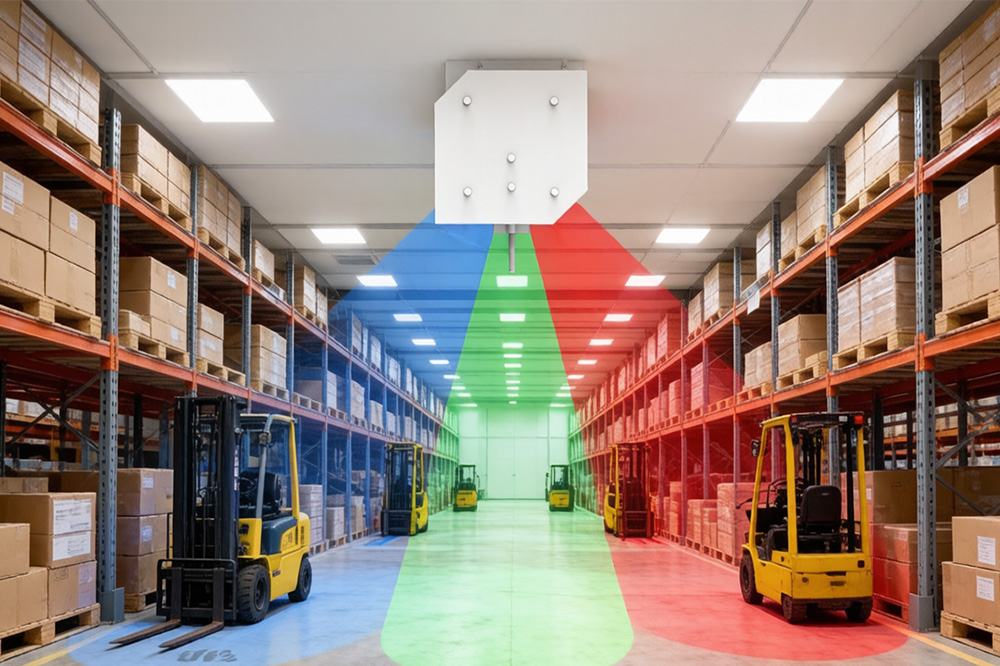
A 30° beam creates a concentrated reading corridor.
That’s useful when tags should only be detected in a specific lane.
A 90° beam covers a much larger area.
That sounds attractive until nearby pallets begin appearing in the system unexpectedly.
A 60° beam often becomes the middle ground.
Not because it’s mathematically ideal.
Because many warehouse layouts happen to fit it reasonably well.
Of course, nearby steel racks, forklifts, and stored goods will still influence the final read zone.
Datasheets describe the antenna.
They don’t describe your building.
This question comes up almost every week.
Which is better?
The honest answer is that neither one is universally better.
It depends on how the RFID tags are positioned.
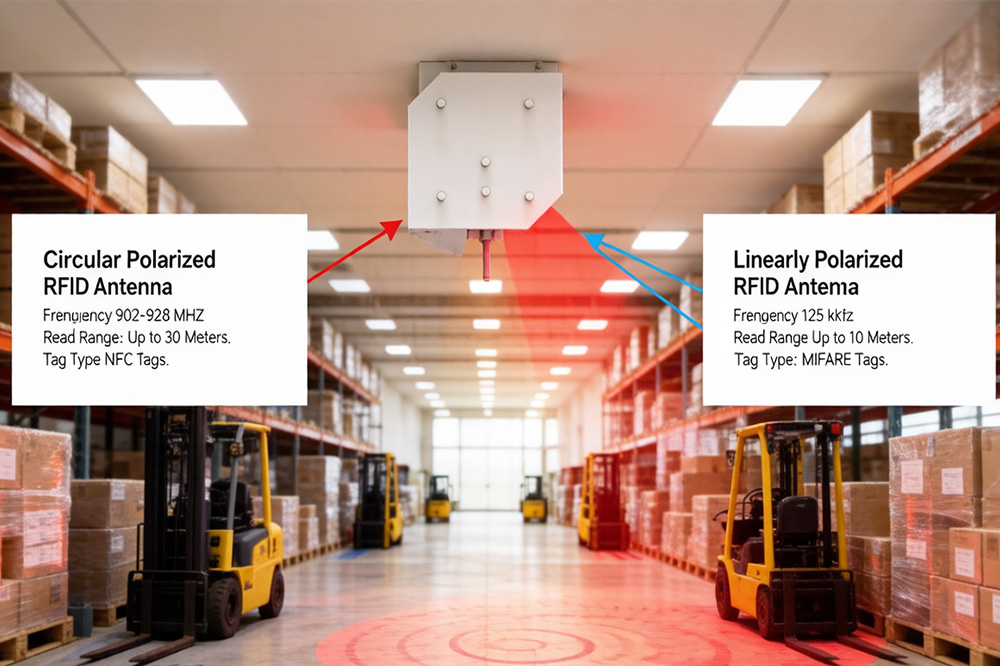
Circularly polarized antennas transmit energy in multiple orientations.
That makes them much more forgiving when tag angles change.
In warehouses, cartons rarely face exactly the same direction.
Workers rotate boxes.
Forklifts tilt pallets.
Products arrive from different suppliers.
Circular polarization handles those variations well.
That’s why it’s probably the most common choice for general RFID applications.
Linear antennas work differently.
They deliver stronger performance when the RFID tag orientation matches the antenna polarization.
If tag positions are fixed and predictable, linear antennas can produce excellent results.
Production lines.
Conveyor systems.
Certain industrial fixtures.
These are environments where linear polarization often makes sense.
The downside is obvious.
Rotate the tag ninety degrees, and reading performance may drop significantly.
Interestingly, experienced procurement teams don’t stop at specifications.
Their questions become much more practical.
Those questions often tell us more about the project than the initial RFQ.
An antenna never works alone.
Reader power.
Installation height.
Beam direction.
Tag placement.
Mounting brackets.
Even cable length can influence system performance.
It’s surprisingly common for two facilities using identical antennas to achieve completely different results because the layouts are different.
That’s why experienced RFID integrators usually evaluate the entire application instead of selecting hardware based only on one specification.
The specification sheet is an important starting point.
It helps narrow the options.
But most successful RFID projects are decided after discussing the application itself.
Warehouse or factory?
Indoor or outdoor?
Fixed gate or moving conveyor?
Mixed pallet orientations or consistent tag placement?
Manufacturers specializing in RFID infrastructure, such as Cykeo, often work with system integrators to recommend antennas based on deployment scenarios rather than simply supplying the highest-gain model.
In many projects, that’s where the real value comes from.
Not from choosing the biggest number on the datasheet.
From choosing the antenna that behaves predictably once the warehouse starts moving.
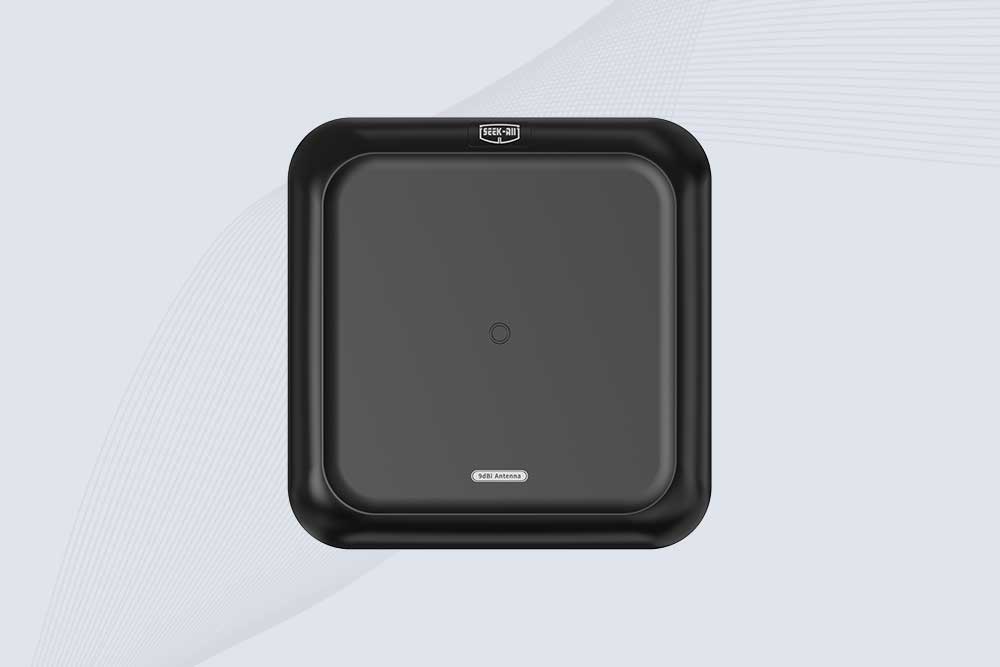
SSD-A11 UHF RFID antenna features 840–960 MHz adjustable frequency, ≥10.5 dBi gain, circular polarization and 50Ω impedance for fixed RFID systems.
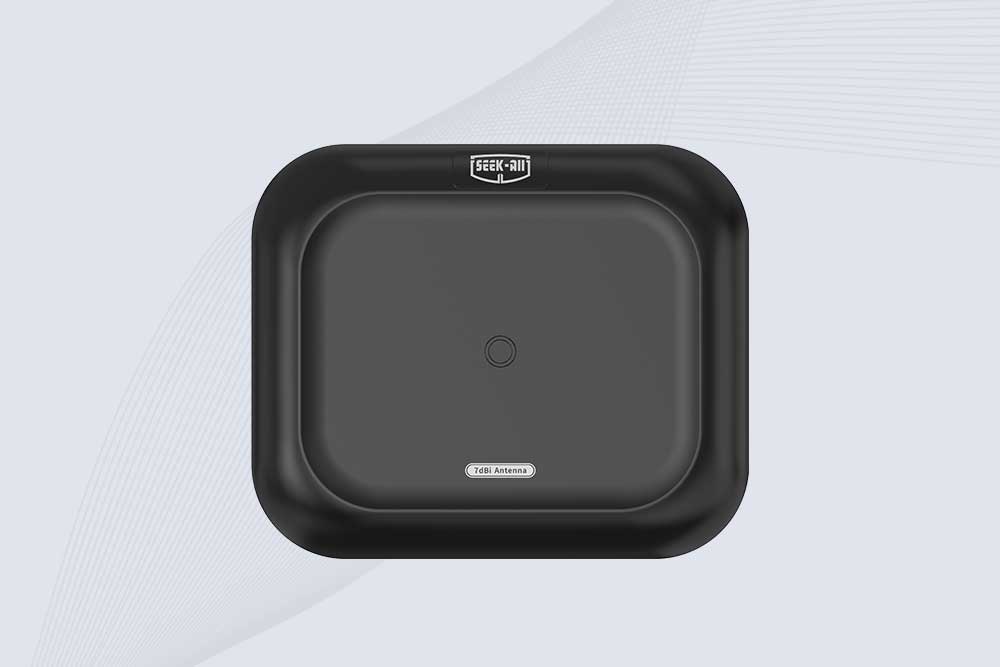
SSD-A09 is a 9 dBi UHF RFID antenna with 840–960 MHz adjustable frequency, circular polarization, 50Ω impedance and directional 60° × 60° coverage.
Explore the SSD-A07 UHF RFID antenna with 7 dBi gain, circular polarization, adjustable 840–960 MHz frequency, and 60°/75° beamwidth for stable RFID read/write performance.

SSD-A06 UHF RFID antenna with circular polarization, adjustable 840–960 MHz frequency, ≥4.5 dBi gain, and a compact directional design for RFID systems.

Cykeo CYKEO-A11 UHF RFID reader antenna delivers 11dBi gain, 840-960MHz frequency range, and IP65 ruggedness for retail, logistics, and industrial RFID systems. Features low VSWR and easy installation.

CYKEO Antenna RFID Reader delivers stable long-range UHF performance with a 10.5dBi directional design, built for warehouses, conveyor portals, and industrial RFID systems. This rfid reader antenna provides 20m+ read distance and rugged IP67 protection.

Cykeo CYKEO-PHF3 industrial HF RFID Antenna offers 24-point dynamic tracking, ISO 14443A/15693 protocols, metal-environment stability for archives/libraries/manufacturing.

Cykeo CYKEO-A5B industrial Linear RFID Antenna delivers 5dBi gain, ≤1.5:1 VSWR, and IP65 rugged design for warehouse, production line, and logistics UHF systems.

Cykeo’s CYKEO-B12 Long Range RFID Antenna delivers 15m+ read range with 12dBi gain, IP65 rugged design, and global 840-960MHz UHF support. Ideal for warehouse/logistics asset tracking.

Cykeo CYKEO-B10 Long Distance RFID Antenna offers 10dBi gain, 840-960MHz frequency range, IP65 rating, and 20m+ coverage for logistics/warehousing/ETC systems. Low VSWR ensures stable signal transmission.

Cykeo CYKEO-A6 UHF RFID panel antenna features 6dBi gain, 840-960MHz broadband, IP65 metal-ready housing for logistics/smart retail. 18mm ultra-thin design with tool-free mounting.

Cykeo CK-A3 industrial antenna RFID UHF offers 5m+ tag detection, ≤1.3:1 VSWR, IP65 rugged design, and global UHF spectrum compatibility (840-960MHz) for warehouses, factories, and retail.

Cykeo CYKEO-B5 directional RFID antenna provides 5dBi gain with 60° narrow beamwidth for precise inventory tracking. IP65-rated, global UHF frequency support, and low VSWR.

Create your own high-performance DIY RFID antenna! 5dBi gain, 840-960MHz tunable, step-by-step guides. Compatible with Arduino, Raspberry Pi, and commercial UHF readers.

Cykeo CYKEO-A7 Flexible RFID Antenna features 840-960MHz wideband tuning, 7dBi gain, and IP68 rating for medical/retail/industrial curved surface deployments. 98% read accuracy with peel-and-stick installation.

Cykeo CYKEO-B5A industrial Passive RFID Antenna delivers 5dBi gain, 70° beamwidth, and -40°C~55°C operation for warehouses/smart cabinets. Compatible with Zebra/Impinj readers.

Cykeo’s CYKEO-A9B High Gain RFID Antenna delivers 15m+ read range with 9dBi amplification. Features IP54 rugged design, 840-960MHz bandwidth, and 80° beamwidth for warehouse/manufacturing RFID systems.

Cykeo’s enterprise-grade 8dbi Impinj RFID Antenna 10m+ read range with 840-960MHz tuning. Features IP65 housing, 1.4 VSWR, 35° beamwidth for retail/warehouse RFID systems.

Cykeo CYKEO-A9 industrial UHF RFID antenna delivers 9dBi gain, 840-960MHz frequency range, and IP65 protection for warehouse/logistics/retail RFID systems. Features N-type connector and ≤1.3:1 VSWR.

CYKEO UHF RFID Antenna built for long-distance and industrial applications. This antenna rfid uhf delivers strong gain, outdoor durability, and reliable tag performance in warehouses, yards, and vehicle ID systems.

CYKEO Antenna RFID delivers reliable long-range UHF performance in warehouses, retail shelves, and cold-chain environments. This compact uhf rfid antenna provides stable reads with circular polarization and ultra-wide 840–960 MHz support, ideal for industrial tracking, smart shelves, and asset monitoring.

Cykeo’s CYKEO-C8 UHF RFID antennas delivers 8dBi gain, 840-960MHz full-band coverage, and IP65 ruggedness for manufacturing/warehouse RFID systems. Industrial RFID Antennas Features

Cykeo’s 8dBi UHF RFID antenna and reader kit delivers 10m+ range, 840-960MHz broadband, and IP65 ruggedness for factories, warehouses, and logistics. ISO 18000-6C & EPC Gen2 certified.

Cykeo CYKEO-A9A industrial UHF RFID reader and antenna kit delivers 10m range, 500 tags/sec, IP65 ruggedness for manufacturing/logistics. Supports EPC Gen2, ISO18000-6C.
Cykeo’s CYKEO-A12C UHF Large RFID Antenna delivers 12dBi gain, 840-960MHz global frequency, IP65 ruggedness for logistics/warehousing/automotive. 40° beamwidth ensures stable 15m+ tag reads.

CYKEO Near Field RFID Antenna provides precise 5–30 cm reading for shelves, cabinets, and workstations. This compact rfid shelf antenna delivers stable short-range performance around metal and clutter, ideal for pharmacies, libraries, and electronics sorting.
RFID Industry Writer | IoT & Asset Tracking Analyst
James writes about RFID technology, asset tracking, and the practical challenges of digital transformation across warehousing, retail, manufacturing, and logistics.
His work focuses on how RFID is applied in real-world operations—improving inventory visibility, automating workflows, and helping businesses manage assets with greater accuracy and efficiency.
He regularly covers topics including UHF RFID, smart cabinets, RFID portals, tool tracking, warehouse automation, and industrial IoT trends..

Learn how to secure RFID readers from cyber threats and protect sensitive data. Discover Cykeo’s best practices for RFID cybersecurity in 2024.
More
Confused about RFID tag vs barcode? Discover how RFID and barcode tech differ in speed, cost, and efficiency. Learn which suits your business needs with Cykeo insights.
More
Wondering what is RFID reader portable? We explain the definition, how it differs from fixed readers, key features, and real-world applications for inventory and asset tracking. Clear guidance from CYKEO engineers.
More
Learn what frequency hopping is in simple terms. Understand how it works, why it’s used in UHF RFID, and how it improves stability in wireless systems.
More