 Cykeo RFID IoT Solution Products R&D Manufacturer
Handheld RFID Reader vs. Fixed Reader: Which Is Better for Retail Stores?
908Compare handheld and fixed RFID readers for retail stores. Learn the pros, cons, and best use cases for each to optimize inventory accuracy and customer experience.
MoreAll RFID Product
Lab logistics tracking is the process of monitoring laboratory assets, chemicals, samples, tools, and consumables throughout their lifecycle using RFID technology, enabling real-time visibility, automated inventory control, secure access management, and complete audit traceability.
In modern laboratories, especially those handling hazardous chemicals, manual registration methods are no longer sufficient. RFID-based lab logistics tracking provides accurate inventory records, automatic movement tracking, and accountability for every item entering or leaving storage.
During a pharmaceutical laboratory deployment I participated in, the most surprising issue was not missing chemicals—it was incomplete usage records.
Researchers were busy.
Bottles were moved between rooms.
Temporary storage became permanent storage.
Nobody intended to violate procedures.
Yet inventory reports rarely matched physical reality.
After implementing RFID-enabled logistics tracking, inventory discrepancies dropped dramatically because every withdrawal, return, and storage event was recorded automatically.
According to the U.S. Occupational Safety and Health Administration (OSHA), proper chemical inventory management is a fundamental requirement for laboratory safety and hazard communication programs.
Source:
The challenge isn’t collecting data.
The challenge is collecting it without interrupting laboratory workflows.
That is where RFID changes everything.
Each chemical container, laboratory asset, sample box, or equipment item receives a unique RFID identity.
Unlike barcode systems, RFID does not require direct line-of-sight scanning.
Benefits include:
Every movement generates a digital record:
| Event | Automatically Recorded |
|---|---|
| Chemical withdrawal | Yes |
| Chemical return | Yes |
| Asset transfer | Yes |
| Inventory audit | Yes |
| User access | Yes |
| Storage location update | Yes |
This creates a complete chain of custody.
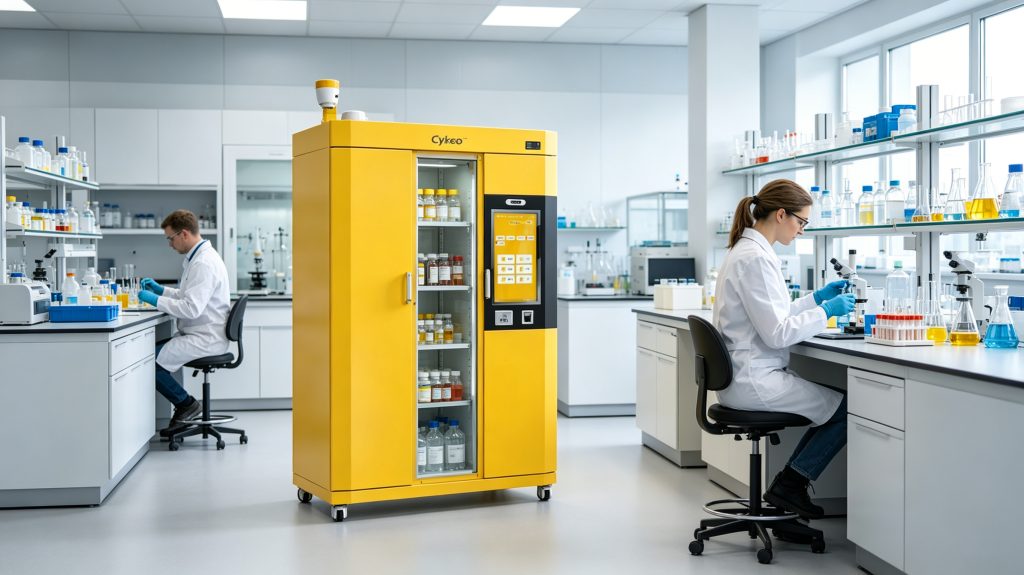
Cykeo’s RFID-enabled hazardous chemical cabinet integrates:
One feature laboratory managers immediately notice is inventory speed.
The cabinet performs automatic inventory verification when the door closes.
Inventory speed reaches approximately 400 tagged items per second.
Instead of conducting manual checks, personnel simply close the cabinet and receive a complete inventory report automatically.
One recurring problem in laboratories is determining who accessed a specific chemical.
RFID tracking combined with facial recognition solves this instantly.
Every event can be associated with:
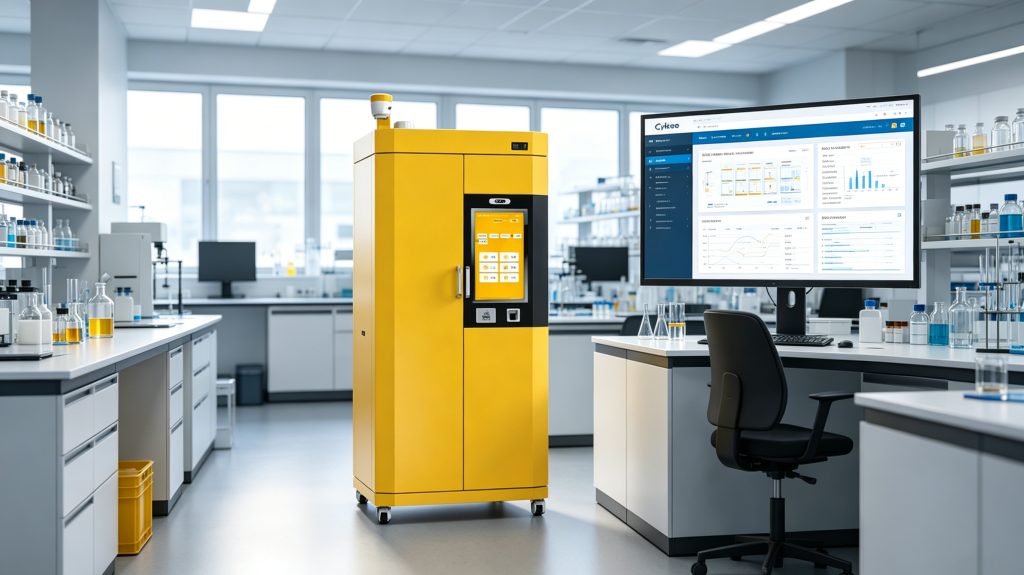
Laboratories often spend significant time preparing audit records.
With RFID tracking, reports can be generated automatically.
This supports:
| Process | Manual Method | RFID Method |
|---|---|---|
| Inventory verification | 30-60 min | Seconds |
| Chemical checkout | Manual registration | Automatic |
| Audit preparation | Several days | Automated reports |
| Item location search | Manual search | Real-time visibility |
| Access records | Paper logs | Digital records |
The efficiency gain becomes especially noticeable in laboratories containing thousands of chemical containers.
I have spent more than a decade working with RFID deployments across industrial facilities, laboratories, aviation maintenance environments, and hazardous material management projects.
One lesson remains consistent:
Most inventory problems are not caused by missing items.
They are caused by missing visibility.
The laboratories that achieve the best results are not necessarily the ones with the largest budgets. They are the ones that eliminate manual recordkeeping wherever possible and capture data automatically at the point of use.
RFID-based lab logistics tracking accomplishes exactly that.
Lab logistics tracking is the process of monitoring laboratory assets, chemicals, samples, and equipment throughout storage, movement, usage, and return activities using technologies such as RFID.
Yes. RFID enables automatic identification and inventory management of hazardous chemicals while maintaining complete access and movement records.
Modern RFID systems typically achieve inventory accuracy above 95% when properly deployed and configured.
Yes. RFID automatically records inventory events, user access, and audit trails, simplifying regulatory compliance and inspection preparation.
Cykeo combines RFID technology, facial recognition, dual-lock security, gas detection, automatic inventory counting, and centralized management into a single laboratory logistics tracking solution.
Lab logistics tracking delivers real-time visibility, safer chemical management, automated inventory control, and complete accountability throughout laboratory operations. With Cykeo RFID solutions, laboratories can replace manual records with accurate, automated, and scalable tracking workflows that improve both safety and efficiency.

Compare handheld and fixed RFID readers for retail stores. Learn the pros, cons, and best use cases for each to optimize inventory accuracy and customer experience.
More
In the era of efficient and precise warehouse management, RFID access control technology, with its unique non-contact identification advantage, is gradually becoming a key tool for optimizing inventory control, accelerating inbound and outbound pr...
More
In modern business, efficiency and accuracy are key to success. Radio Frequency Identification (RFID) technology has become a game-changer across industries, and the four-port RFID reader has emerged as a powerful tool for enhancing operational ef...
More
Discover why iPhones can't emulate RFID cards natively. Learn how Cykeo's Bluetooth device turns your iPhone into an RFID emulator for keycards & badges.
More