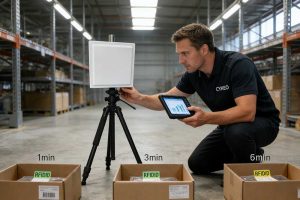
You walk through a warehouse doorway and every pallet is counted automatically. You wave a handheld across a shelf and instantly know what needs restocking. You drive through a toll booth and the fee is deducted without stopping.
All of these moments rely on a UHF RFID reader—the device that makes long-range, high-speed identification possible.
Here is the thing. When people search uhf rfid reader, they usually want to understand what makes this technology different from the RFID they already know, and which type they need for their application.
A UHF RFID reader (Ultra-High Frequency Radio Frequency Identification reader) is a device that uses radio waves in the 860-960 MHz frequency range to communicate with UHF RFID tags, reading and sometimes writing data to them . Unlike low-frequency (125 kHz) or high-frequency (13.56 MHz) readers, UHF readers can read tags from meters away, hundreds at a time, without line of sight .
Think of it like a supercharged barcode scanner that does not need to see the barcode. A UHF reader can identify every item on a pallet in seconds, even if those items are inside boxes or stacked behind each other.
UHF RFID readers are also called UHF interrogators, RAIN RFID readers, or simply UHF scanners. They are the backbone of modern supply chain automation, warehouse management, and retail inventory systems.
How a UHF RFID Reader Works
The technology relies on a clever physical principle called backscatter modulation. Here is what happens when a UHF reader interrogates tags:
The reader transmits. The UHF RFID reader sends out a continuous radio wave at a specific frequency within the 860-960 MHz band. For passive tags, this wave does double duty—it carries commands and provides energy .
Tags harvest energy.Passive UHF RFID tags have no battery. Their antenna collects energy from the reader’s signal, powers the tiny microchip, and prepares to respond .
Tags modulate the reflection. Instead of transmitting their own radio signal (which would require a battery), the tag simply changes how much of the reader’s signal it reflects. This creates a pattern in the reflected signal that encodes the tag’s stored data .
The reader listens. The reader captures these faint reflected signals, amplifies them, and decodes the data. Because tags reflect rather than transmit, they consume very little power and can last decades without batteries .
Anti-collision handles multiple tags. When hundreds of tags are in the field, they would normally collide and become unreadable. UHF readers use sophisticated anti-collision algorithms (based on time-division multiple access) to sort out responses, reading all tags in seconds .
Key Specifications of UHF RFID Readers
When evaluating UHF readers, these specifications determine real-world performance :
Frequency Range: UHF readers must match the regional frequency band. North America uses 902-928 MHz (FCC). Europe uses 865-868 MHz (ETSI), with some countries now allowing an upper band (915-921 MHz) .
Transmit Power: Measured in dBm or watts. Higher power generally means longer range. Regional regulations limit maximum power: 4W EIRP in North America, 2W ERP in Europe (about 3.2W EIRP) .
Receiver Sensitivity: How faint a signal the reader can detect. Measured in dBm, with lower (more negative) numbers indicating better sensitivity. Better sensitivity means longer range and better performance in challenging environments .
Read Speed: Tags per second. Modern UHF readers achieve 200-500+ tags per second with advanced anti-collision .
Antenna Ports: Fixed readers often have multiple ports (4, 8, or even 16) for connecting external antennas to cover different zones .
Communication Interfaces: USB, Ethernet, Wi-Fi, Bluetooth, RS232, RS485, GPIO for integration with host systems .
Types of UHF RFID Readers
UHF readers come in several forms, each suited to different applications :
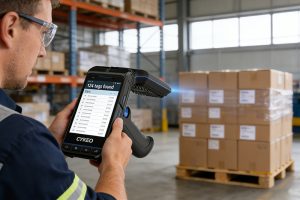
Handheld UHF Readers are portable, battery-powered devices carried by workers. They are designed for mobility—you walk through aisles, point at pallets, and pull a trigger to scan hundreds of tags in seconds. The CYKEO CK-B5L reads over 500 tags in under 3 seconds from up to 8 meters away. Perfect for warehouse cycle counting, retail inventory, and field operations .
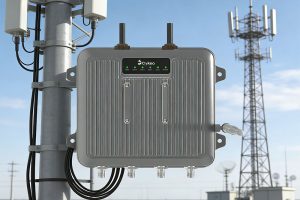
Fixed UHF Readers are stationary devices mounted on walls, doorways, conveyors, or production lines. They work automatically, reading tags as they pass without human involvement. The CYKEO CK-R8L supports up to 8 external antennas, covering wide areas like dock doors and conveyor lines. Ideal for portals, automated checkpoints, and manufacturing lines .
Desktop UHF Readers sit on counters next to computers. They have short, focused read ranges (typically a few centimeters to 30 cm) and are perfect for precision encoding one tag at a time. Used for tag programming, card enrollment, and small-scale verification .
Mobile UHF Readers attach to smartphones via USB-C or Bluetooth, turning phones into powerful RFID scanners. The CYKEO CK-B4L is a compact USB rfid reader that fits in a pocket, perfect for delivery personnel and field technicians .
Embedded UHF Modules are bare circuit boards designed to be built inside other products—printers, kiosks, medical devices, smart cabinets. These provide UHF reading capability without taking up extra space .
UHF vs. HF vs. LF: Why UHF Dominates
UHF has become the standard for supply chain and inventory applications because of its unique advantages :
Feature
UHF (860-960 MHz)
HF (13.56 MHz)
LF (125 kHz)
Read range
3-12+ meters
Up to 1 meter
Up to 10 cm
Read speed
Hundreds/second
One at a time
One at a time
Line of sight
Not required
Short range, can read through some materials
Short range
Tag cost
Low ($0.05-$0.50)
Moderate
Low
Global standard
ISO 18000-6C (EPC Gen2)
ISO 14443, ISO 15693
Various
Typical use
Supply chain, inventory
Access control, payments, NFC
Animal ID, older access
UHF’s long range and high speed make it the only practical choice for reading hundreds of items at once without manual scanning.
Applications of UHF RFID Readers
UHF readers are transforming industries across the board :
Warehouse and Logistics: Fixed readers at dock doors automatically read incoming and outgoing pallets. Handheld readers cycle-count entire aisles in hours instead of days. Conveyor readers sort packages at high speed .
Retail Inventory: Store staff use handheld UHF readers to scan entire sales floors quickly. Overhead readers provide continuous, real-time inventory visibility. Inventory accuracy reaches 99% .
Supply Chain: UHF readers track cases and pallets through every handoff. Shipments are verified at each stage. Errors are caught early .
Manufacturing: Readers track work-in-progress through production lines. Each station reads tags automatically, providing real-time visibility into bottlenecks .
Asset Tracking: UHF readers locate expensive equipment, tools, and IT assets. Fixed readers at zone boundaries track movement. Handheld readers find specific items .
Healthcare: UHF readers track medical equipment, surgical instruments, and pharmaceuticals. Smart cabinets ensure critical items are always available .
UHF RFID Reader Range Factors
Read range depends on several factors :
Reader power: Higher transmit power increases range. Maximum is limited by regional regulations .
Antenna gain: Higher gain antennas focus energy, increasing range but narrowing coverage area .
Tag sensitivity: Better tags respond from farther away. High-performance tags cost more .
Environment: Metal reflects signals, creating nulls and dead zones. Water absorbs UHF energy. Interference from other readers reduces range .
Tag orientation: UHF tags are directional. A tag facing edge-on to the antenna may not read. Circular polarization antennas help by reading tags in any orientation .
Choosing the Right UHF RFID Reader
Start by asking these questions :
What is your application? Warehouse inventory needs a handheld. Automated portal needs a fixed reader with multiple antennas. Tag encoding needs a desktop reader .
What read range do you need? Handhelds read 3-8 meters. Fixed readers with high-gain antennas reach 10-15 meters .
What environment? Indoor warehouses need dust protection. Outdoor installations need weather resistance. Cold storage needs low-temperature operation .
How many tags at once? For dense populations, look for high read speed (200+ tags/sec) and advanced anti-collision .
What connectivity? Real-time updates need Wi-Fi or Ethernet. Mobile applications need Bluetooth .
What integration? Ensure the reader’s SDK supports your development platform. CYKEO provides SDKs for Python, Java, C#, and Android .
The Bottom Line
A UHF RFID reader is the device that makes long-range, high-speed identification possible. It uses radio waves in the 860-960 MHz band to communicate with UHF tags, reading hundreds of tags per second from meters away without line of sight.
UHF readers come in many forms—handheld for mobility, fixed for automation, desktop for precision encoding, and embedded modules for integration. The right choice depends on your application, environment, and workflow.
CYKEO offers a complete range of UHF RFID readers—CK-B5L handheld for inventory, CK-R8L fixed for portals, CK-D1L desktop for encoding, and CK-B4L mobile for smartphone integration. All are built for industrial reliability and backed by full SDK support.
When you are ready to move from manual scanning to the speed and efficiency of UHF RFID, start by understanding your tags, your environment, and your workflow. Then choose the reader that fits. CYKEO can help you every step of the way.
Need a UHF RFID reader for your application? CYKEO offers demo units for qualified projects. Test the CK-B5L in your warehouse with your tags. Contact our team to arrange a demo.
A simple breakdown of RFID hardware, including tags, readers, and antennas. Learn how each part works and how RFID systems improve tracking, automation, and visibility.
Frustrated with short read distances? Learn how to increase RFID reader range with proven tips on antennas, tag placement, and software tuning from CYKEO engineers.
Wondering what is RFID reader portable? We explain the definition, how it differs from fixed readers, key features, and real-world applications for inventory and asset tracking. Clear guidance from CYKEO engineers.
 Cykeo RFID IoT Solution Products R&D Manufacturer