 Cykeo RFID IoT Solution Products R&D Manufacturer
Trends and Forecasts for the RFID Healthcare Asset Management Market, 2025-2034
214The RFID Healthcare Market is set for rapid growth from 2025 to 2034. Explore market size, forecasts, key players, regional trends, and asset tracking insights.
MoreAll RFID Product
People often describe the RFID printer market as “steadily growing.” That statement is technically correct, but it hides what is really happening on the ground.
Based on multiple industry tracking sources and shipment data, the global RFID printer market is expected to move from around USD 2.15 billion in 2025 to approximately USD 4.28 billion by 2035, which translates to a CAGR of about 7.3%. These numbers are not explosive, and that matters. This is not a hype-driven market. It is an infrastructure market.
RFID printers tend to grow quietly, following operational pain rather than innovation headlines.
Between 2020 and 2024, many deployments were still described as pilots. Warehouses tested RFID on selected SKUs. Retailers experimented with item-level tagging. Hospitals ran RFID systems in limited departments.
That phase is largely over.
From 2025 onward, RFID printers are being purchased because something already broke: inventory accuracy dropped, manual checks failed, or compliance audits became too frequent. In these situations, RFID printing is not a “technology upgrade.” It is damage control.
Retail and e-commerce are still the most visible adopters. Vertical retail models, especially fashion and consumer electronics, rely on RFID labels printed at scale to keep stock data aligned across channels. Once item-level tracking is introduced, printers become permanent fixtures, not optional equipment.
Logistics operators tell a similar story. RFID printers sit at inbound points, printing and encoding labels before goods enter automated systems. When this step is removed or delayed, error rates rise fast. Most operators learn that lesson once.
Healthcare adoption moves slower, but for different reasons. Compliance, privacy, and system validation take time. Still, RFID printers are increasingly used for medical supplies, patient wristbands, and equipment tracking. In hospitals, printers are chosen conservatively, but once approved, they stay in service for years.
Manufacturing uses RFID printing in a less visible way. Work-in-progress tracking, tool identification, and quality checkpoints quietly rely on printed RFID labels. In high-value production, one missing label can stop a line.
Despite the growth, resistance remains.
Initial cost is the most obvious barrier. RFID printers are not purchased alone. RFID Tags, Fixed RFID Reader, RFID antennas, software integration, and sometimes facility upgrades follow. For small and mid-sized companies, the budget question often ends the discussion early.
Integration is the second issue, and it is underestimated. RFID printers must talk to ERP systems, warehouse software, or hospital databases. When this connection fails, operators blame the printer, even if the issue sits elsewhere.
Security concerns are real, not theoretical. RFID systems introduce wireless data into environments that were once closed. Unauthorized access, data leakage, or interference can create serious problems, especially in regulated industries.
These issues do not stop adoption, but they slow decision-making. Many projects move forward only after a previous manual system fails.
Not every “trend” deserves attention. Some do.
Tag miniaturization is one of them. Smaller tags require tighter printing tolerances. Printers that handled older labels without issue sometimes struggle with newer designs. This has pushed manufacturers to rethink encoding accuracy and quality control.
Sustainability is another shift, but it is uneven. Biodegradable and recyclable RFID labels are gaining traction, mainly because regulations and procurement rules are tightening. Printers now need to handle new materials without compromising print quality.
Cloud connectivity is becoming common, not because it is fashionable, but because maintenance teams need it. Remote diagnostics, firmware updates, and performance monitoring reduce downtime. In these environments, printers operate alongside RFID readers and tags as part of a connected system. Suppliers like CYKEO, which focus on RFID readers and RFID tag, usually enter these deployments indirectly, through system integrators rather than marketing campaigns.
AI and IoT influence how printing decisions are made, not how printers work mechanically. Predictive models inform when labels should be printed and in what volume. Waste reduction, not speed, is often the goal.
Growth rates vary widely by region, and the reasons are structural.
China is expected to see the fastest growth, with a projected CAGR of around 10.2%. Manufacturing scale, e-commerce penetration, and government-backed digitalization programs all contribute.
South Korea follows closely at about 9.0%, supported by early adoption and strong electronics supply chains.
The United States maintains solid growth at approximately 8.2%, driven by logistics scale and healthcare requirements.
Germany’s growth (around 7.4%) reflects its industrial base and Industry 4.0 initiatives. Other European markets grow steadily but more cautiously, shaped by regulation and earlier adoption cycles.
These differences are not temporary. They reflect how deeply RFID is embedded in daily operations.
Industrial RFID printers dominate the market, accounting for roughly 55% of total shipments. These machines are built for volume, durability, and continuous operation. Once installed, they rarely leave.
Desktop RFID printers represent about 25% of the market. They serve offices, clinics, and small warehouses where space and cost matter more than throughput.
Thermal transfer printing leads because durability still matters. Direct thermal printing remains popular for short-life labels, especially in shipping and retail.
The market is competitive but stable. Zebra Technologies, Honeywell, SATO, Avery Dennison, and Toshiba Tec continue to lead, largely because they understand operational environments rather than chasing novelty.
In real deployments, RFID printers are evaluated together with readers and tags. Performance is judged by system behavior, not individual devices. Printers that integrate smoothly into existing RFID ecosystems tend to survive procurement cycles.
Supply chain disruption remains a concern. RFID printers depend on semiconductors and specialized components. Price volatility and lead times still affect delivery schedules.
Cybersecurity is an ongoing issue. RFID networks are only as secure as their weakest link. Encryption, access control, and regular updates are mandatory, not optional.
Regulatory complexity also persists. Data privacy rules, spectrum regulations, and labeling standards vary by region. Non-compliance can delay or cancel deployments.
The RFID printer market does not move fast, but it moves forward. Growth is driven by necessity, not optimism. Companies adopt RFID printing when manual systems fail or when visibility becomes non-negotiable.
Between 2025 and 2035, RFID printers will increasingly function as infrastructure components within digital supply chains. They will not attract attention, and that is precisely why they will keep selling.

The RFID Healthcare Market is set for rapid growth from 2025 to 2034. Explore market size, forecasts, key players, regional trends, and asset tracking insights.
More
Walk into almost any modern warehouse today and you’ll notice something different compared to five years ago. Fewer clipboards.Fewer manual barcode scans.More antennas mounted above dock doors and conveyor belts. That shift is largely driven ...
More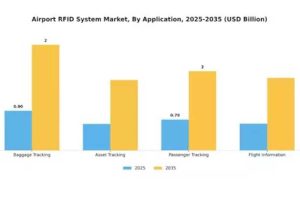
The Airport RFID Systems Market is expected to grow steadily from 2025 to 2035. This report analyzes market size, CAGR, key drivers, technology trends, and regions.
More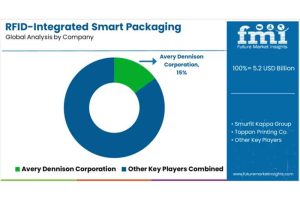
RFID-integrated smart packaging market forecast from 2025 to 2035, covering market size, CAGR, technology trends, applications, and regional growth insights.
More