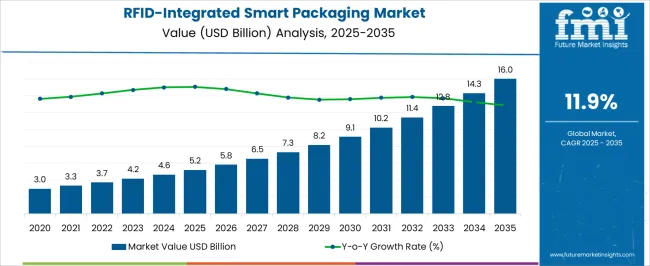
The RFID-integrated smart packaging market is projected to be valued at $5.2 billion in 2025 and will reach $15.6 billion by 2035. This growth represents an absolute increase of $10.4 billion over the entire decade, reflecting a compound annual growth rate (CAGR) of 11.9%. This trend suggests that the overall market size will triple within the forecast range.
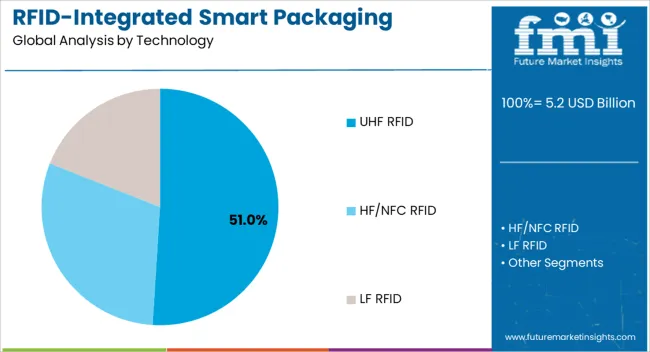
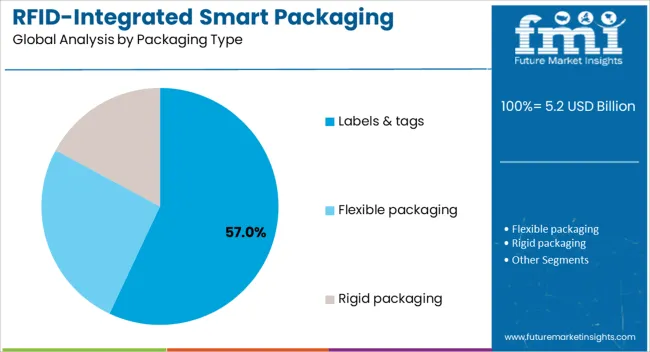
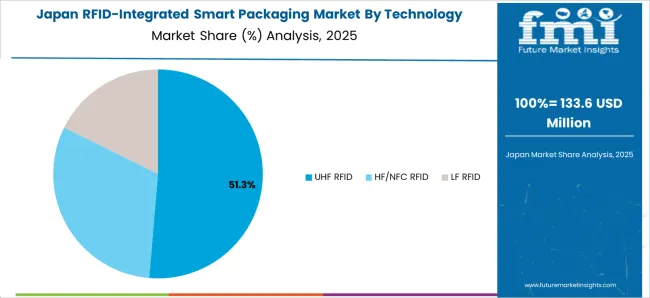
In the initial phase from 2025 to 2030, the market size is projected to grow from $5.2 billion to $9.2 billion, an increase of nearly $4 billion, representing approximately 38% of the total decade-long expansion. This phase is expected to be shaped by the greater adoption of UHF RFID systems in food and beverage applications, as supply chain transparency and anti-counterfeiting remain central. UHF RFID is expected to anchor this growth momentum with a 51.0% share in 2025, while tags and labels will continue to lead with a 57.0% share.
Valuation is projected to accelerate from the second half of 2030 to 2035, rising from $9.2 billion to $15.6 billion, an increase of $6.4 billion, representing 62% of total growth. This period is expected to be supported by strong pharmaceutical demand, with serialized and tracked formulations exceeding the market average. The personal care and cosmetics sectors are also expected to strengthen their contribution, benefiting from the premium brand protection segment growing at a CAGR of over 12.0%.
I. Rapid Statistics on the RFID-Integrated Smart Packaging Market
RFID Integrated Smart Packaging Market Value (2025): US$5.2 billion
RFID Integrated Smart Packaging Market Forecast Value (2035): US$15.6 billion
RFID Integrated Smart Packaging Market CAGR Forecast (2025-2035): 11.9%
Leading Segment in 2025: UHF RFID (51.0%)
Major Growth Regions: North America, South Asia & Pacific, Europe
Key Players in the RFID Integrated Smart Packaging Market: Avery Dennison, Smurfit Kappa Group, Toppan Printing, Sealed Air, Zebra Technologies, Checkpoint Systems, SATO Holdings, Identiv, UPM Raflatac, CCL Industries
II. Key Points of the RFID-Integrated Smart Packaging Market
Scale
Value
Estimated Value of RFID Integrated Smart Packaging Market (2025E)
US$5.2 billion
Forecast Value of RFID Integrated Smart Packaging Market (2035F)
US$15.6 billion
CAGR Forecast (2025-2035)
11.9%
Between 2020 and 2024, the market for RFID-integrated smart packaging steadily expanded, driven by food and beverage manufacturers adopting smart packaging to achieve consistent visibility across the supply chain and reduce counterfeiting in processed products. During this period, global suppliers dominated, controlling a significant portion of industry revenue through extensive technology portfolios and robust distribution networks. Differentiation was primarily based on label reliability, compliance, and cost-effectiveness, while digital integration services and real-time tracking capabilities remained under development and contributed limited to total value.
Demand is projected to reach $5.2 billion by 2025, with revenue structures shifting as the pharmaceutical and logistics industries accelerate. Traditional packaging leaders are expected to face increasing competition from technology-driven suppliers offering integrated RFID solutions with comprehensive data analytics for location services. Leading existing players are expected to shift to a hybrid model to remain relevant by integrating advanced sensors, blockchain connectivity, and AI-driven analytics platforms. Emerging players focused on sustainability and circular economy applications are expected to expand their market share, particularly in the Asia Pacific region, where demand for smart logistics and brand protection is growing rapidly.
III. Why is the RFID-integrated smart packaging market growing?
The growth of the RFID-integrated smart packaging market is driven by supply chain transparency requirements and anti-counterfeiting needs in the food, pharmaceutical, logistics, and personal care sectors. Increased consumer awareness of product authenticity, tracking capabilities, and compliance is translating into greater application of UHF RFID, HF/NFC remote identification, and integrated sensor technologies in smart packaging formulations.
Regulatory scrutiny of pharmaceutical serialization has further fueled the shift towards digital supply chains, prompting manufacturers to prioritize proven, technology-driven tracking systems. The demand for logistics and supply chain packaging, particularly in e-commerce and retail distribution, has accelerated the adoption of specialized RFID integration solutions. The food and beverage industry is further supporting this momentum by integrating smart packaging for freshness monitoring and inventory management. Advances in miniaturization and cost reduction have facilitated greater accessibility and adoption, ensuring the viability of long-term applications.
IV. Segmented Analysis
The RFID-integrated smart packaging market is segmented by technology type, application, packaging type, end-user industry, and region. Each category reflects the diverse adoption paths and performance priorities driving demand across industries. Technology type segmentation includes UHF RFID, NFC RFID, and LF RFID. By application area, the market encompasses food and beverage, pharmaceuticals, logistics and supply chain packaging, and personal care and cosmetics, each representing unique demand drivers. In terms of packaging type, the market is segmented into labels and tags, flexible packaging, and rigid packaging. By end-user industry, the market is segmented into food and beverage manufacturing, pharmaceutical companies, logistics and distribution, personal care manufacturers, and retail and e-commerce. Regionally, the market covers Europe, North America, Asia Pacific, and the rest of the world.
1.Insights into Leading UHF RFID Technology Segments
UHF RFID is projected to dominate the market with a 51.0% market share by 2025, surpassing other technologies with its superior read range and scatter scanning capabilities. Growth will be driven by supply chain applications requiring inventory management across large warehouses and distribution centers, where remote reading offers operational efficiency advantages. UHF RFID is projected to grow at a CAGR of 12.5% through 2035, making it the leading growth engine in the category. HF/NFC RFID is expected to see more modest growth at 11.2%, while maintaining its relevance to consumer-facing applications. With increasing importance of automation and large-scale deployment, UHF RFID is expected to solidify its role as a mainstay of smart packaging innovation.
2.Application Segment Insights of Leading Companies in the Food and Beverage Sector
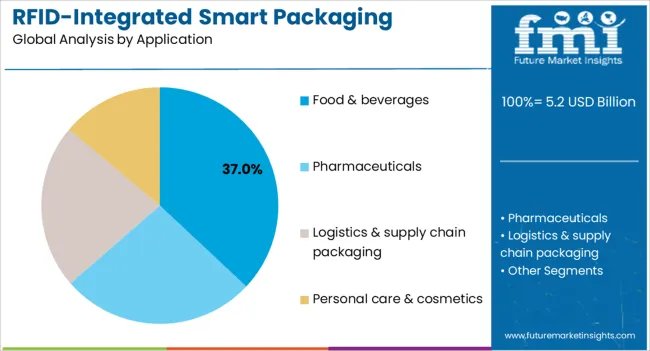
The food and beverage sector is projected to lead with a 37.0% share by 2025, driven by continued demand for supply chain transparency, freshness monitoring, and inventory optimization. Cold chain management, expiration date tracking, and anti-counterfeiting applications will support demand, further strengthened by increased consumption of packaged and processed foods. The pharmaceutical industry is expected to achieve faster growth at a CAGR of 12.8%, particularly in areas of serialization and traceability demand. While personal care and cosmetics have a smaller share at only 14.0%, they are projected to expand at a rate of 12.3%, making them a high-potential growth channel. With accelerating global regulatory compliance and brand protection, applications in healthcare and premium consumer goods are expected to increasingly complement the dominance of traditional food and beverage uses.
3.Insights into the packaging type segment where labels and labeling remain the dominant choice.
Labels and tags are projected to maintain their leading position with a 57.0% market share by 2025, favored for their compatibility with existing packaging infrastructure and cost-effective integration across multiple product categories. The ease of application, scalability, and ability to adapt to existing packaging lines make labels and RFID tags the preferred format for manufacturers. While labels and RFID tag dominate, flexible packaging is expected to achieve a CAGR of 12.4%, driven by technological advancements that enhance the integration of RFID with films and bags. Rigid packaging will continue to serve specialized applications in the pharmaceutical and electronics sectors, but labels and tags will remain the most scalable and cost-effective solution. With the expansion of personalized packaging and advanced supply chain tracking, labels and tags are expected to continue to maintain their leading position while complementing other packaging innovations.
V. What are the driving factors, limiting factors, and key trends in the RFID-integrated smart packaging market?
Regulatory changes, evolving supply chain requirements, and technological advancements are reshaping the smart packaging market with integrated RFID. While transparency requirements and anti-counterfeiting measures support expansion, implementation costs, infrastructure limitations, and integration complexities present obstacles that companies must strategically overcome by 2035.
1、Integrate into supply chain digitization and tracking platforms
The market for RFID-integrated smart packaging is being strengthened by its integration into a comprehensive supply chain digitization framework, with smart packaging serving as an end-to-end, visualized data collection point. Retailers and manufacturers are increasingly embedding RFID technology into packaging to enable real-time inventory management, reduce inventory build-up, and improve the accuracy of demand forecasting.
Pharmaceutical companies are leveraging integrated solutions to achieve serialization compliance, creating detailed audit trails from manufacturing to patient delivery. As digital supply chain platforms expand, RFID packaging with cloud connectivity and analytics capabilities is expected to become a strategic differentiator in consumer and healthcare product portfolios.
2、Cost and infrastructure barriers for small and medium-sized enterprises
Market growth is constrained by high initial implementation costs and infrastructure requirements, which particularly impact SMEs. RFID integration requires specialized printing equipment, reader infrastructure, and software systems, all of which necessitate significant capital expenditures exceeding traditional packaging investments.
The technical expertise required for system integration, label programming, and data management presents additional barriers for companies lacking dedicated IT resources. Compatibility issues with legacy packaging equipment further complicate adoption, especially for manufacturers with established production lines. This cost structure is expected to limit adoption by small businesses, potentially concentrating market growth in large enterprises with sufficient resources for comprehensive technology integration.
VI. Analysis of the RFID-integrated smart packaging market by major countries
Country
Compound Annual Growth Rate
China
12.9%
India
13.4%
Germany
12.2%
United States
11.7%
United Kingdom
10.9%
Japan
10.5%
Brazil
10.1%
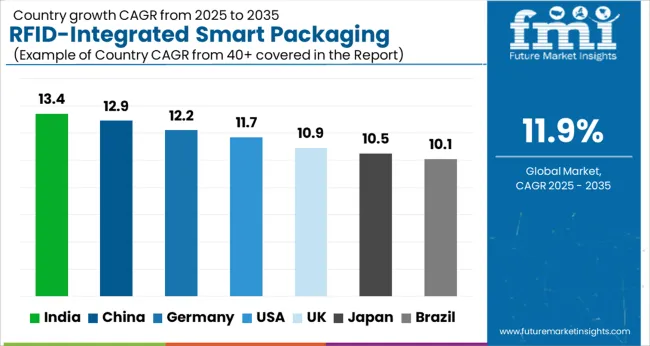
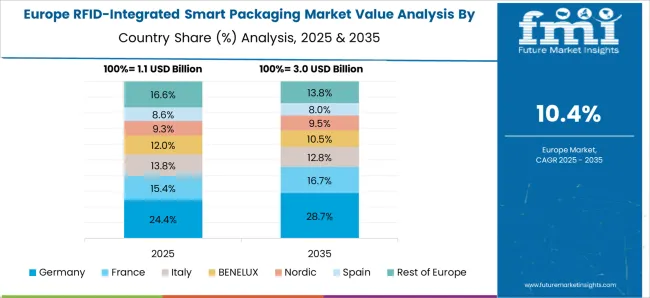
The RFID-integrated smart packaging market exhibits diverse national development trajectories, reflecting varying regulatory frameworks, digital maturity, and supply chain complexity. Asia’s momentum is projected to be led by India (13.4% CAGR) and China (12.9%), with growing demand for pharmaceutical traceability, digitalized food retail, and e-commerce security expected to be driven by supportive policies and expanding manufacturing capacity. The US is projected to grow at a CAGR of 11.7%, driven by steady adoption in the pharmaceutical and food industries as FDA regulations and supply chain security initiatives gain increasing attention. Europe will continue to be a high-value hub, with Germany leading at 12.2% CAGR, benefiting from EU requirements for pharmaceutical serialization and sustainable traceability. The UK is projected to grow at 10.9% CAGR, primarily driven by retail-driven adoption, while Japan’s 10.5% CAGR reflects technology integration in the pharmaceutical and consumer electronics sectors. Brazil’s 10.1% CAGR makes it a pillar of Latin America, benefiting from anti-counterfeiting programs in the food and beverage sector.
1、Sales Outlook for RFID-Integrated Smart Packaging in the United States
The US RFID-integrated smart packaging market is projected to grow from $1.2 billion in 2025 to $3.7 billion in 2035, representing a CAGR of 11.7%. The growth momentum is expected to remain strong, with an annual growth rate between 10.8% and 12.5%, demonstrating the resilience of the pharmaceutical, food and beverage, and logistics industries.
This expansion is primarily driven by FDA and DSCSA traceability regulations, which require drug serialization and comprehensive supply chain documentation. Food safety regulations are expected to strengthen adoption as manufacturers focus on contamination prevention, recall efficiency, and inventory optimization. The logistics and supply chain industry is also expected to accelerate the integration of RFID solutions to align with e-commerce growth and warehouse automation trends.
As manufacturers emphasize real-time visualization and predictive capabilities, a shift towards comprehensive data analytics platforms integrated into RFID packaging is anticipated. Strategic partnerships between packaging manufacturers and technology suppliers are expected to increase market penetration among mid-sized enterprises. By 2035, the U.S. is projected to maintain its technology leadership position, supported by regulatory frameworks that encourage supply chain digitization and advanced tracking solutions.
Drug serialization and FDA compliance will remain the biggest drivers of application.
Food safety and inventory management will see accelerated adoption in retail and manufacturing.
Technology integration and data analytics capabilities will drive growth in high-end market segments.
2、Growth and Expansion Outlook for the Indian RFID-Integrated Smart Packaging Market
The Indian RFID-integrated smart packaging market is projected to grow at the fastest CAGR globally (13.4%) between 2025 and 2035, driven by government initiatives promoting pharmaceutical traceability and the rapid digitization of food retail infrastructure. Strong policy support for the adoption of digital supply chains and manufacturing technologies is expected to provide significant market momentum. Government initiatives requiring drug serialization and anti-counterfeiting measures are expected to drive demand in the pharmaceutical industry, while the expansion of organized retail and e-commerce platforms will accelerate applications in the food and beverage sector.
Growth is expected to benefit from improved domestic capabilities in RFID technology and packaging material manufacturing, reducing import dependence and enhancing cost competitiveness. The country’s large pharmaceutical manufacturing base and growing consumer goods sector provide a viable market for smart packaging solutions. Technology transfer projects and foreign direct investment in manufacturing are expected to boost local production capacity and reduce implementation costs.
The development of logistics and cold chain management infrastructure is expected to generate additional demand for temperature-sensitive and inventory management applications.
Digital payment system integration and consumer awareness campaigns on product authenticity are expected to support market acceptance. India is projected to become a key manufacturing hub for RFID-integrated packaging solutions, serving both domestic and international markets, by 2035.
Government mandates for drug traceability have driven the adoption of regulatory compliance.
Digitalization in fast-food retail has created opportunities for the consumer goods industry.
Domestic manufacturing capabilities have improved cost competitiveness and market access.
Infrastructure modernization supports the application of logistics and cold chain management.
3、Demand Analysis for RFID-Integrated Smart Packaging in China
China’s RFID-integrated smart packaging market is projected to grow at a CAGR of 12.9% from 2025 to 2035, primarily driven by supply chain security needs in the pharmaceutical and e-commerce industries. China’s position as a global manufacturing hub and technology leader is expected to accelerate domestic adoption while supporting export-oriented production capacity. Strong government support for digital infrastructure and Industry 4.0 initiatives provides a favorable policy framework for smart packaging implementation.
E-commerce platforms and logistics companies are expected to be the primary drivers of adoption, implementing RFID solutions for inventory management, authenticity verification, and delivery optimization. The pharmaceutical industry faces increasing regulatory pressure regarding product serialization and supply chain transparency, creating significant demand for integrated tracking solutions. Consumer goods manufacturers are expected to adopt smart packaging for brand protection and consumer interaction applications.
China’s technological integration capabilities and manufacturing scale advantages have made it a cost-effective supplier in the global market. Investments in sensor technology, data analytics, and packaging materials R&D are expected to enhance product innovation and competitiveness. In developing countries, Chinese packaging solutions offer cost-effective export opportunities that are anticipated to supplement domestic demand.
The e-commerce and logistics industries have driven the adoption of large-scale inventory management.
Pharmaceutical serialization requirements have created opportunities for regulatory compliance.
Manufacturing capabilities and cost advantages support both domestic and export markets.
Technological innovations in sensors and analytics have enhanced global competitiveness.
4.In-depth analysis of Germany’s demand for RFID-integrated smart packaging
The German RFID-integrated smart packaging market is projected to grow at a CAGR of 12.2% between 2025 and 2035, primarily driven by EU requirements for pharmaceutical serialization and sustainable traceability. The country’s leading position in manufacturing technology and compliance creates favorable conditions for the adoption of advanced packaging solutions. Strong automotive, pharmaceutical, and consumer goods industries offer diverse application opportunities across multiple sectors.
Compliance requirements under the EU’s Counterfeit Medicines Directive are expected to drive demand in the pharmaceutical industry, while sustainability reporting obligations create opportunities for supply chain transparency applications. German manufacturers’ focus on Industry 4.0 and digital transformation supports the integration of smart packaging solutions with existing production systems. High-end consumer goods companies are expected to adopt RFID packaging to protect their brands and promote consumer engagement.
Germany’s technological development capabilities in sensors, embedded systems, and data analytics have positioned it as an innovation leader in smart packaging solutions. Export opportunities in the EU market and developing economies, which benefit from Germany’s competitive advantage due to its engineering reputation, are expected to complement domestic growth. Collaboration among packaging manufacturers, technology providers, and end-user industries has created a comprehensive ecosystem supporting market expansion.
EU drug serialization regulations have driven the adoption of regulatory compliance in the healthcare industry.
Sustainability tracking requirements have created opportunities for supply chain transparency applications.
Industry 4.0 initiatives and manufacturing technology leadership support comprehensive solution integration.
Focus on high-end consumer goods and export capabilities enhance market growth potential.
5、In-depth analysis of Japan’s demand for RFID-integrated smart packaging
The Japanese RFID-integrated smart packaging market is projected to grow at a CAGR of 10.5% between 2025 and 2035, driven by stringent food safety regulations, advanced logistics infrastructure, and increasing consumer expectations for product authenticity and quality assurance. Japan’s leading position in electronics, sensor technology, and miniaturization provides a solid foundation for the widespread adoption of RFID packaging solutions. Key industries such as pharmaceuticals, food and beverage, automotive, and high-value consumer electronics offer diverse application opportunities.
Government initiatives promoting food traceability, drug safety, and sustainable packaging are expected to accelerate market adoption. Japan’s focus on Society 5.0 and digital transformation policies supports the integration of RFID with IoT, AI, and blockchain platforms to achieve real-time supply chain transparency. Consumer preferences for premium, safe, and sustainable products encourage adoption by food brands, luxury goods, and the personal care industry.
Japan’s technology-driven innovation ecosystem, combined with its global leadership in electronic and semiconductor components, makes it a key hub for RFID smart packaging R&D. Export opportunities in the Asia-Pacific region are expected to complement Japan’s reputation for quality and precision manufacturing, further fueling domestic growth. Strategic collaborations among packaging companies, technology suppliers, and logistics operators foster a comprehensive ecosystem supporting RFID adoption.
Food safety and pharmaceutical traceability regulations have driven adoption in the healthcare and food service sectors.
Sustainability and circular economy goals have fueled demand for smart packaging-driven recycling and waste reduction.
Society 5.0 and digital transformation initiatives support the integration of RFID with the Internet of Things and artificial intelligence to enable smart logistics.
High-end consumer electronics and export-driven industries have enhanced the market potential in the Asia-Pacific region.
VII. Competitive Landscape of the RFID-Integrated Smart Packaging Market
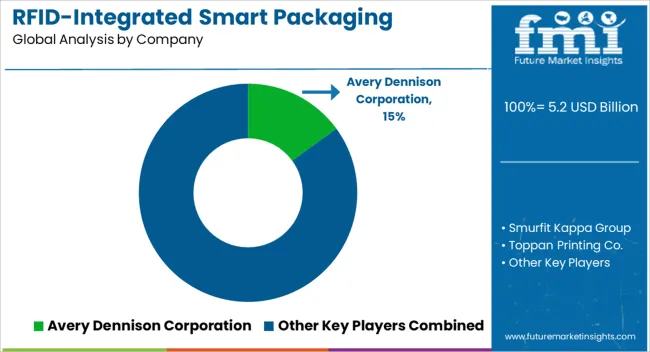
The smart packaging market with integrated RFID is moderately fragmented, with global leaders, established packaging companies, and technology specialists competing across multiple application segments. Global leaders such as Avery Dennison Corporation, Smurfit Kappa Group, and CCL Industries hold significant market positions with comprehensive technology portfolios, integrated manufacturing capabilities, and established customer relationships across multiple industries. Their approach increasingly focuses on complete solutions that integrate RFID hardware, software platforms, and application support services.
Established technology companies, including Zebra Technologies, Checkpoint Systems, and SATO Holdings, are actively addressing the demand for dedicated RFID readers, software integration, and data management platforms. Their strengths lie in their technological expertise, systems integration capabilities, and vertical market specialization in retail, healthcare, and logistics. Value-added services, including consulting, training, and ongoing technical support, are being used to strengthen customer relationships and increase solution adoption.
Specialized packaging suppliers and regional technology companies focus on dedicated solutions for pharmaceutical serialization, food safety, and brand protection applications. Their flexibility in tailoring solutions to specific industry needs and meeting local regulatory compliance requirements gives them a competitive edge despite their limited global scale.
Competitive differentiation is expected to continue shifting toward integrated ecosystems that combine hardware reliability, software functionality, and data analytics capabilities to ensure full visibility and compliance across the end-user customer’s supply chain.
The RFID blood monitoring system market is projected to grow from USD 127.4 million in 2024 to USD 234.7 million by 2034, driven by traceability requirements, hospital digitization, and regulatory compliance in blood management.
An in-depth look at the RFID printer market from 2025 to 2035, covering growth drivers, risks, regional trends, and real-world adoption across key industries.
The RFID signage system market is projected to grow rapidly from 2025 to 2035. This report analyzes market size, CAGR, key segments, regional trends, and drivers.
 Cykeo RFID IoT Solution Products R&D Manufacturer