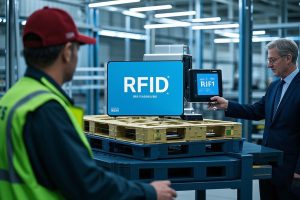
RFID for material handling enables automatic identification, real-time tracking, and intelligent movement of raw materials, work-in-progress, and finished goods. By combining RFID tags, industrial readers, and management software, Cykeo solutions reduce handling errors, improve inventory visibility, and accelerate warehouse and manufacturing operations.
Why Is RFID for Material Handling Becoming Essential?
RFID for material handling solves a problem that warehouse managers face every day: materials rarely stay where the system believes they are.
A pallet leaves receiving.
Someone temporarily places it beside another production line.
A forklift moves it again before the ERP updates.
Within hours, production planners are searching instead of manufacturing.
After participating in RFID deployments across manufacturing plants, distribution centers, and industrial warehouses, our engineering team has found that the greatest efficiency gain comes from eliminating manual confirmation—not simply speeding it up.
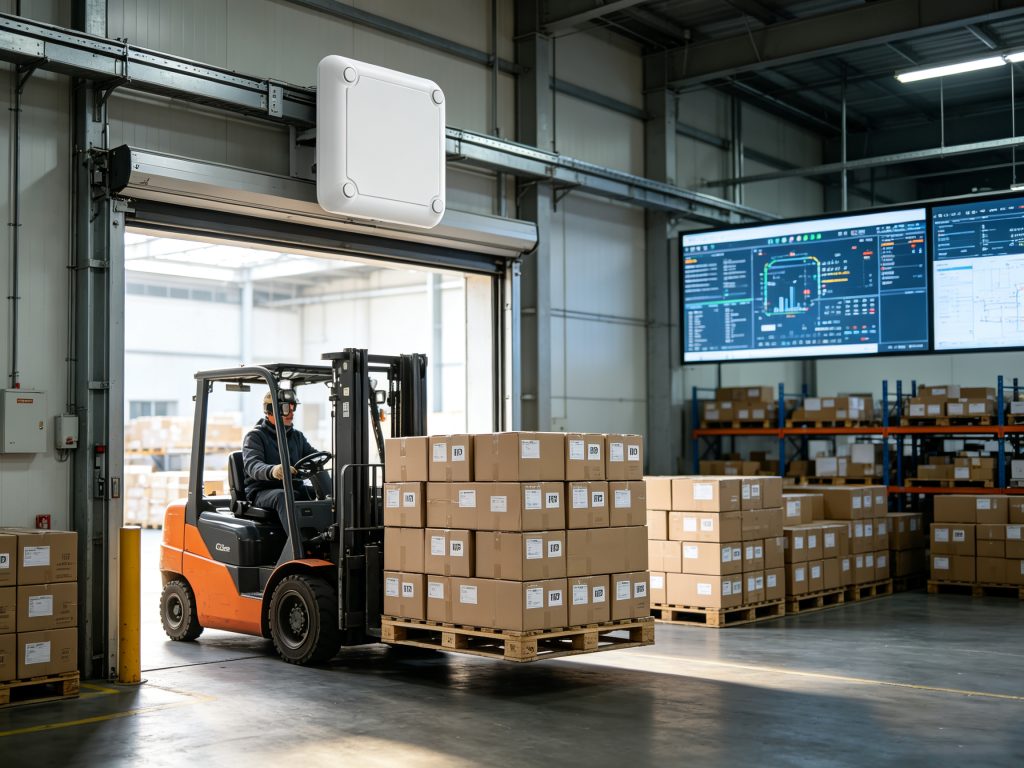
RFID readers automatically identify tagged materials whenever they pass loading docks, production entrances, storage aisles, or shipping gates. Material movements are captured instantly without requiring operators to stop, scan, or enter data manually.
According to GS1, RFID significantly enhances inventory visibility, traceability, and supply chain efficiency by enabling automatic data capture throughout logistics operations.
Materials are automatically identified without manual barcode scanning.
How RFID for Material Handling Works
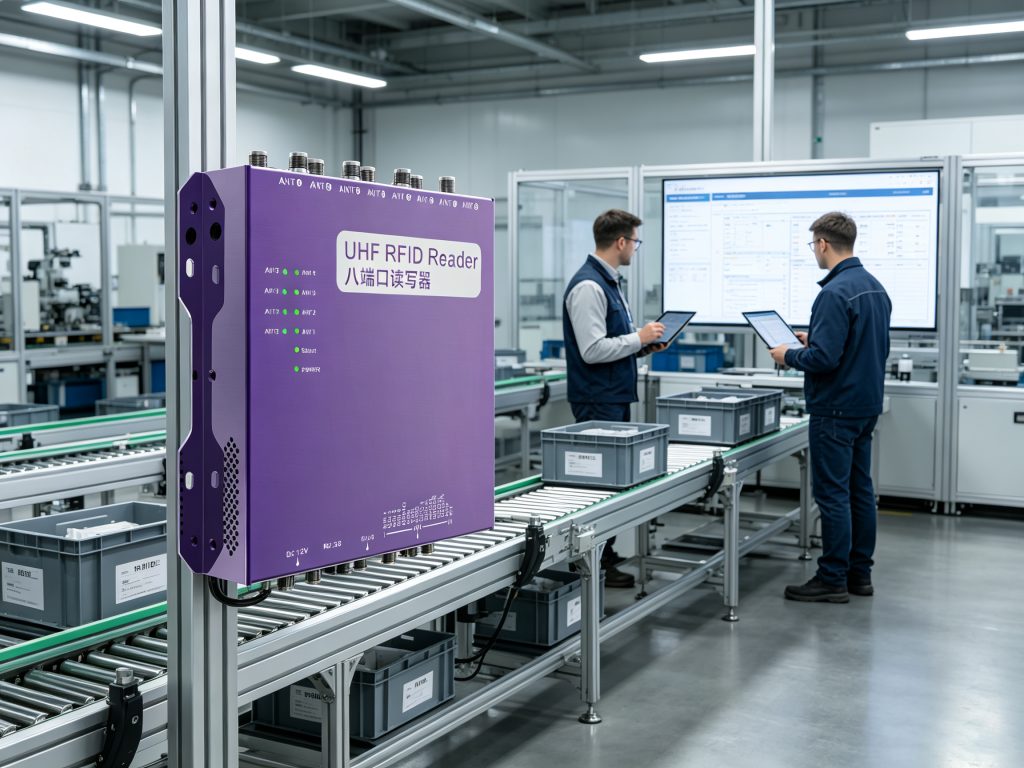
A complete material handling solution consists of four connected components.
Ensure reliable reading coverage at key checkpoints
Management Software
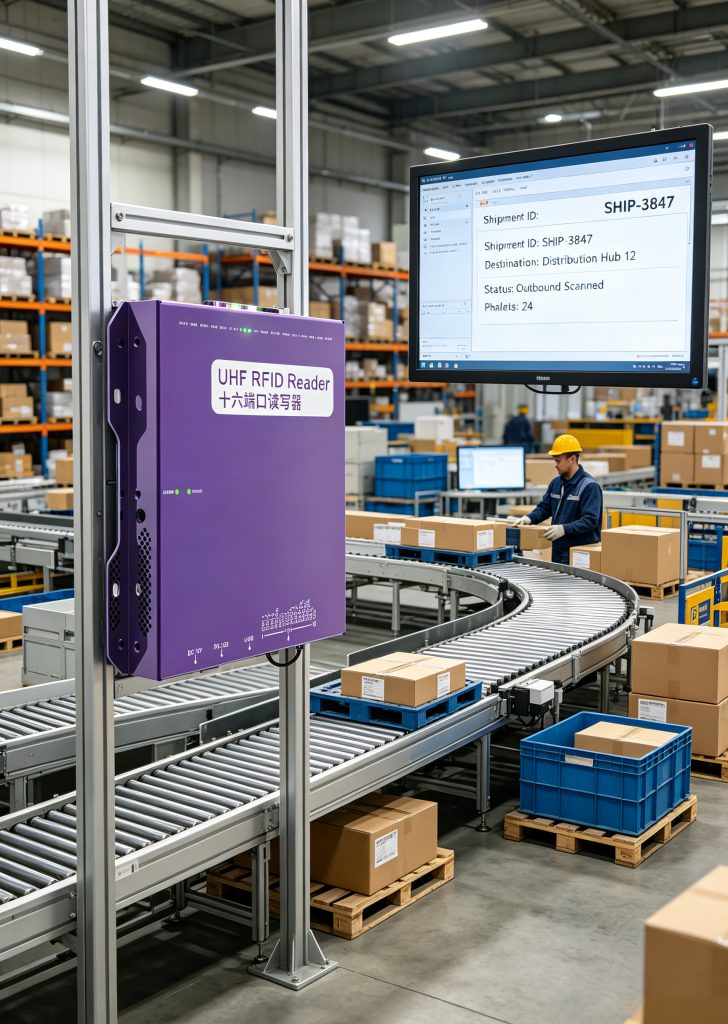
Displays movement history, inventory status, alerts, and reports
Unlike barcode systems, RFID identifies multiple tagged materials simultaneously without requiring direct line-of-sight.
This allows forklifts, carts, conveyors, and automated guided vehicles (AGVs) to continue moving without interruption.
Typical Materials Tracked
Raw materials
Steel coils
Plastic containers
Electronic components
Finished products
Returnable transport items (RTIs)
Production bins
Assembly kits
Chemical containers
Packaging materials
Measured Operational Improvements
One deployment remains particularly memorable.
A manufacturer stored thousands of reusable material containers across several production buildings. Operators frequently spent valuable time searching for empty containers rather than processing orders.
After RFID gate readers were installed between warehouse zones, every movement became visible in real time.
The search problem simply disappeared.
Instead of asking, “Where is the container?”, supervisors opened the dashboard and immediately located it.
According to RAIN Alliance, billions of passive RFID tags are now deployed annually across manufacturing, logistics, healthcare, and retail industries, reflecting rapid enterprise adoption of RFID automation.
Additionally, Deloitte notes that greater supply chain visibility through digital technologies helps organizations improve operational resilience and decision-making across logistics networks.
Every material movement is automatically recorded in real time.
Applications Across Material Handling Operations
Warehouse Receiving
Automatically verify inbound materials without manual counting.
Production Supply
Track raw materials from warehouse storage directly to production lines.
Work-in-Progress Tracking
Monitor semi-finished products between manufacturing processes.
Shipping Verification
Confirm outbound materials before loading trucks.
Returnable Asset Management
Track reusable pallets, containers, cages, and transport racks throughout their lifecycle.
Why Manufacturers Choose Cykeo
Industrial RFID environments are challenging.
Metal shelving creates signal reflections.
Forklifts introduce unpredictable movement.
Materials often stack tightly together.
These realities require far more than installing readers on warehouse walls.
Cykeo engineers evaluate:
Material composition
Warehouse layout
Read zone dimensions
Forklift travel paths
Conveyor speed
Tag orientation
Environmental interference
Required reading accuracy
Only after understanding these conditions do we recommend reader placement and antenna configuration.
This engineering-first approach consistently delivers higher read reliability than relying on maximum transmission power alone.
Cykeo provides:
Industrial fixed RFID readers
UHF RFID handheld readers
Embedded RFID modules
Industrial RFID antennas
RFID middleware
API & SDK support
OEM customization
Technical integration assistance
Designed for continuous industrial operation and enterprise integration.
Key Benefits of RFID for Material Handling
Operational Advantages
Automatic material identification
Real-time warehouse visibility
Reduced handling errors
Faster inventory reconciliation
Lower labor costs
Improved production scheduling
Continuous movement history
Enterprise software integration
Frequently Asked Questions
Is RFID suitable for metal materials?
Yes. Using specialized on-metal RFID tags and properly engineered antenna placement, Cykeo solutions achieve reliable performance even in challenging industrial environments.
Can RFID replace barcode scanning?
For many material handling processes, yes. RFID identifies multiple items simultaneously without requiring direct line-of-sight, greatly reducing manual scanning.
Can RFID integrate with ERP, MES, or WMS?
Absolutely. Cykeo provides SDKs and APIs for seamless integration with ERP, WMS, MES, warehouse automation platforms, and other enterprise systems.
Which industries benefit most?
Manufacturing, automotive, logistics, aerospace, pharmaceuticals, electronics, food processing, and industrial warehousing all benefit from RFID-enabled material handling.
Final Thoughts
As manufacturing and logistics operations continue to demand faster throughput and greater inventory accuracy, rfid for material handling has become a foundational technology for intelligent material flow. By combining industrial-grade RFID hardware, automated identification, real-time visibility, and seamless enterprise integration, Cykeo helps organizations eliminate manual bottlenecks, reduce material handling errors, and optimize warehouse performance. Whether managing raw materials, work-in-progress, returnable containers, or finished goods, rfid for material handling provides the reliable, scalable infrastructure needed to support modern industrial operations.
A long range RFID scanner for retail inventory can identify multiple tagged products at once, helping retailers speed up stock counting, improve inventory ac...
RFID gate access control systems designed for solution providers and integrators. Explore gate readers, antenna integration, and secondary development for custom access control projects.
Boost RFID tag read range with handheld readers using antenna adjustments, tag placement, and power settings. Learn actionable strategies for warehouses and outdoor use.
How much does an RFID tool cabinet cost? Discover key pricing factors, cost ranges, and how to choose the right RFID tool tracking system for your budget.
 Cykeo RFID IoT Solution Products R&D Manufacturer