All RFID Product

how to build rfid tracking system

Cykeo News RFID FAQ 00

To build an RFID tracking system, define your use case, select tags and readers, design antenna layout, integrate software, and validate with real-world testing for accuracy and stability.

In practice, system success depends less on theory—and more on tuning signal coverage, tag placement, and data filtering.

RFID system design guide

Start with the real problem, not the hardware

In field projects, the biggest mistake is buying devices before defining workflow.

Ask first:

  • What are you tracking? (assets, pallets, people?)
  • Required accuracy? (zone-level vs item-level)
  • Read environment? (metal shelves, outdoor gates?)

A warehouse project I worked on initially failed because tags were selected before testing metal interference. We replaced standard labels with anti-metal tags—accuracy jumped from 82% to 97% overnight.

According to GS1 , properly designed RFID deployments can achieve over 99% inventory accuracy, compared to ~65% in manual systems.

core components of an RFID tracking system

What you actually need

ComponentPurposeDeployment Note
RFID TagsStore item identityChoose UHF for long range
RFID ReaderReads/writes dataFixed vs handheld matters
AntennasControl RF coveragePlacement = performance
MiddlewareFilters & processes dataRemoves duplicate reads
Backend SystemStores & visualizesERP/WMS integration

A system is only as strong as its weakest link—usually antenna placement, not the reader itself.

selecting the right hardware

Matching equipment to environment

From real deployments using Cykeo devices:

  • CYKEO-RA12L (Fixed Reader)
    • 12dBi high-gain antenna
    • Ideal for gates, yard management
    • Strong anti-interference for outdoor use
  • CYKEO-B5L (Handheld Reader)
    • 10000mAh battery
    • Flexible for inventory cycles
    • Works well in dense environments
  • CYKEO-D2L (Desktop Writer)
    • Near-field encoding within 30cm
    • High write success rate
    • Useful for tag initialization

The difference between a stable system and a frustrating one often comes down to using the right reader for the scenario—not the most expensive one.

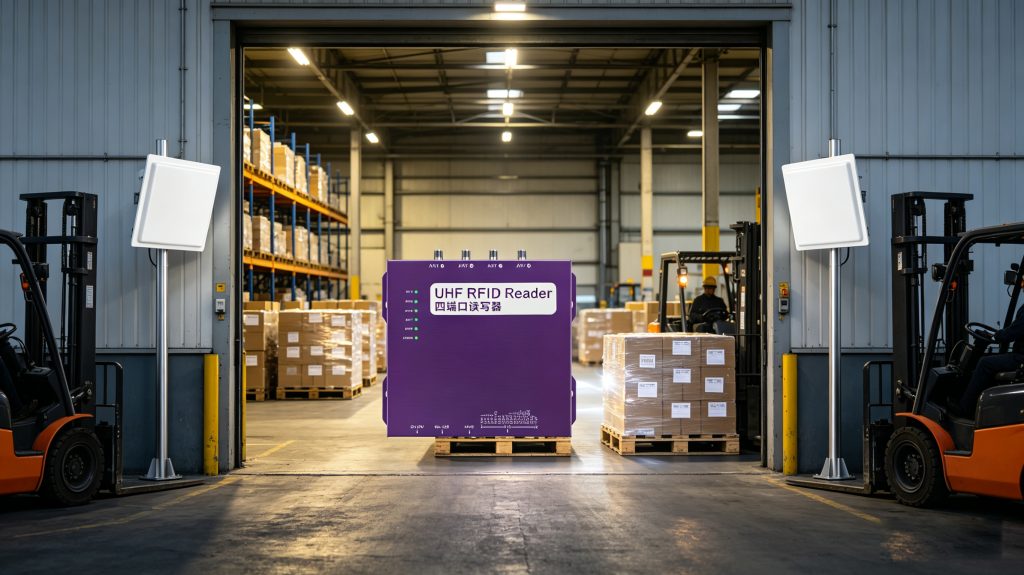
RFID tracking system gate with fixed reader and antennas scanning pallets
Fixed RFID readers and antennas create controlled read zones for accurate tracking

how to design antenna layout

Coverage is everything

RFID doesn’t “see” like a camera—it radiates. Poor layout creates blind spots.

Key field rules:

  • Angle antennas (30–45°) for better coverage
  • Avoid placing directly near metal surfaces
  • Use multiple antennas instead of increasing power

In one logistics hub, adding a second antenna reduced missed reads by 60% without changing reader power.

According to RAIN RFID Alliance , antenna configuration is the #1 factor influencing read reliability in UHF systems.

software integration & data filtering

Raw data is messy—clean it early

RFID generates massive duplicate reads. Without filtering:

  • Systems overload
  • False movements appear
  • Reports become unreliable

Typical filtering logic:

  • Time-based filtering (ignore duplicates within X seconds)
  • Zone-based filtering
  • Event triggers (entry/exit detection)

A clean middleware layer often reduces data volume by 70–90% before it reaches ERP systems.

testing and optimization in real environments

Lab success means nothing without field validation

Real-world interference changes everything:

  • Forklifts block signals
  • Human movement affects reads
  • Tag orientation varies constantly

Testing checklist:

  • Walk test with handheld reader
  • Simulate peak traffic
  • Validate read rates at different times

In practice, expect at least 2–3 rounds of tuning before reaching stable performance.

typical deployment timeline

What to expect

PhaseDurationKey Output
Planning1–2 weeksRequirements & layout
Hardware setup1 weekInstalled readers & antennas
Integration2–3 weeksSoftware connected
Testing2 weeksOptimized performance

Total: ~4–8 weeks for a mid-scale project.

FAQ

How much does it cost to build an RFID tracking system?

Costs vary widely, but small systems start around a few thousand dollars, scaling based on reader count and integration complexity.

What frequency should I choose?

UHF (860–960 MHz) is best for long-range tracking; HF/NFC suits short-range applications.

How accurate is RFID tracking?

With proper setup, accuracy can exceed 95–99% in controlled environments.

Can RFID replace barcodes?

Not entirely, but RFID significantly improves automation and bulk reading efficiency.

final field insight

Building an RFID system isn’t about assembling components—it’s about shaping behavior in a noisy physical world.

The best-performing systems I’ve seen weren’t the most complex. They were the ones where:

  • antennas were adjusted repeatedly
  • tag placement was standardized
  • data was aggressively filtered

That’s the difference between a demo and a production system.

And that’s exactly what defines how to build rfid tracking system successfully in real operations.

PgUp:

Relevance

View more