 Cykeo RFID IoT Solution Products R&D Manufacturer

Can Flipper Zero Read RFID? Let’s Get Real.
874Trying to use a Flipper Zero for RFID tasks? This no-nonsense guide explains its real-world capabilities, its hard limits, and when you truly need an industrial system.
MoreAll RFID Product
You’ve got a RFID reader sending out power and a passive tag with no battery. So, how do RFID tags modulate—or encode—their data to send it back? It’s a question that trips up a lot of folks new to RFID integration. The textbook answer is “backscatter modulation,” but what does that actually mean on your warehouse floor or in your asset tracking setup?
Let’s ditch the complex theory. Imagine you’re in a dark room with a flashlight (the reader) and a small mirror (the tag). You shine the light at the mirror to see it. To send a message, the mirror doesn’t light up itself. Instead, it tilts slightly, changing how your flashlight’s beam reflects back to you. A quick tilt might mean a “1,” and a hold might mean a “0.” Your eyes (the reader) decode that pattern of bright and dim reflections.
That’s essentially how do RFID tags modulate. The tag uses its RFID antenna to reflect the reader’s own radio wave energy back, but it intelligently alters that reflection to create a pattern—the digital code containing its unique ID. It does this by the chip switching its electrical load, changing the antenna’s reflectivity.
The Two Ways This Happens (And Why Your Choice Matters)
In practice, especially with UHF systems, this alteration happens in two main ways. Picking the wrong one for your environment is a common reason for troubleshooting rfid tag communication issues.
So, What Does This Mean for Your Project?
Understanding how do RFID tags modulate isn’t just academic. It explains the “why” behind frustrating performance gaps.
In short, the modulation is the tag’s way of talking back by smartly mirroring the reader’s signal. Knowing whether it “blinks” or “wobbles” that mirror can be the difference between a reliable system and one that drops reads when you need them most.
Trying to use a Flipper Zero for RFID tasks? This no-nonsense guide explains its real-world capabilities, its hard limits, and when you truly need an industrial system.
More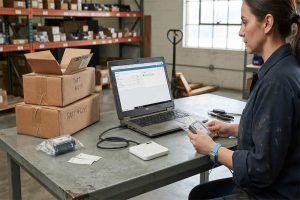
USB RFID tag reader connects RFID-tagged products or assets with a computer-based inventory system through USB. It can be a practical choice for desktop inve...
More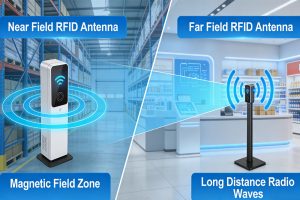
Near-field and far-field antennas play different roles in RFID systems. Learn how they work, their advantages, and how RFID solution providers choose the right antenna for different applications.
More
Discover how RFID medical cabinets work to secure, track, and manage hospital inventory. Learn about their components, benefits, and real-world applications in healthcare.
More