Associating RFID tag IDs with data in a MySQL database involves capturing tag data, structuring your database, and creating a seamless integration between hardware and software. This process is essential for applications like asset tracking, inventory management, and access control. Here’s a detailed guide to achieve this efficiently.
1. Database Design for RFID Tag Management
Table Structure:
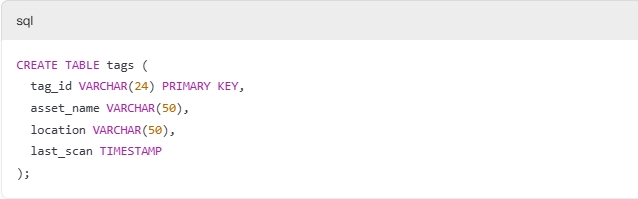
Create a tags table with columns for tag_id (unique RFID UID), asset_name, location, timestamp, and other relevant fields.
Relationships:
Link the tags table to other tables (e.g., employees, inventory) using foreign keys for expanded functionality.
2. RFID Hardware Setup
Reader Configuration:
Use an RFID reader (e.g., Cykeo’s USB-Enabled Reader) to capture tag IDs and transmit them to your system via USB, Bluetooth, or HTTP.
Data Capture:
Ensure the reader outputs the tag’s UID in a compatible format (e.g., hexadecimal or decimal).
3. Software Integration
Middleware or Custom Script:
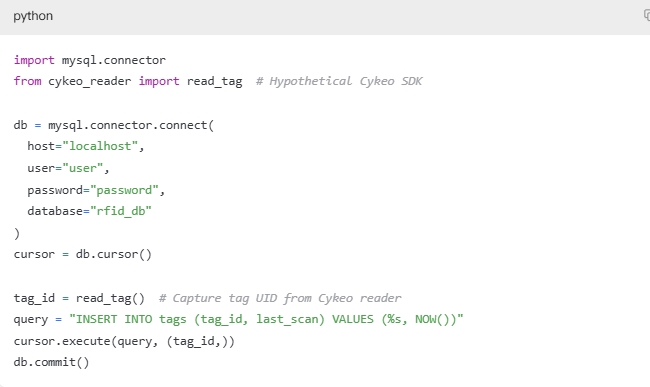
Develop a Python/PHP script to read tag IDs from the reader and insert them into the MySQL database.Example Python snippet:
4. Associating Tag IDs with Data
Dynamic Data Binding:
Use web forms or mobile apps to link tag IDs to asset details (e.g., assign a tag to a laptop or employee badge).
Automated Workflows:
Trigger actions (e.g., send alerts, update inventory counts) when a tag is scanned using MySQL triggers or external APIs.
5. Cykeo’s Cloud-Based Solutions
Cykeo Sync Platform:
Automate RFID-to-database syncing without coding. Prebuilt templates support MySQL, PostgreSQL, and cloud databases.
API Integration:
Use Cykeo’s REST API to push tag data directly to your MySQL instance for real-time updates.
6. Maintenance & Security
Data Validation:
Sanitize inputs to prevent SQL injection attacks.
Backup & Optimization:
Schedule regular database backups and index frequently queried columns (e.g., tag_id, last_scan).
Case Study: Warehouse Efficiency Boosted by 35%
A logistics company automated inventory tracking using Cykeo’s RFID-to-MySQL integration, reducing manual data entry errors and cutting audit times by 35%.
A technical guide for selecting long-range RFID readers for industrial applications. Covers reading distance, throughput, protocol compatibility, and environmental durability for warehouses, production lines, and gate access systems.
Searching “how to bypass RFID reader” often points to security concerns. We detail the risks of cloning & jamming, and how CYKEO’s encrypted systems provide real protection.
Ever wonder how an RFID reader actually works? This article breaks it down in a human way — how the reader talks to tags, what happens in warehouses or metro gates, and why it’s quietly powering daily life everywhere.
Discover why RFID readers outperform barcodes in speed, accuracy, and scalability. Learn how Cykeo’s RFID solutions can transform your business operations.
 Cykeo RFID IoT Solution Products R&D Manufacturer