When Clothing Meets RFID: The Starting Point of Digital Transformation in Apparel
As garment manufacturing and retail become increasingly efficient, traditional barcode labels can no longer meet the needs for fast inventory, accurate tracking, and smart recommendations. RFID (Radio Frequency Identification) technology, with its advantages of contactless and batch reading, is quietly redefining the functionality of clothing tags. By embedding micro RFID chips, garments can not only be identified and recorded but also gain data communication and intelligent management capabilities.
Principles and Structure of RFID Clothing Tags
An RFID system mainly consists of tags, readers, and middleware. Clothing tags are typically passive, activated by electromagnetic waves emitted from the reader which then reflect back information. Different frequency bands (such as UHF, HF) adapt to varying reading distances and data transmission rates, with UHF RFID especially suitable for retail and laundry tracking.
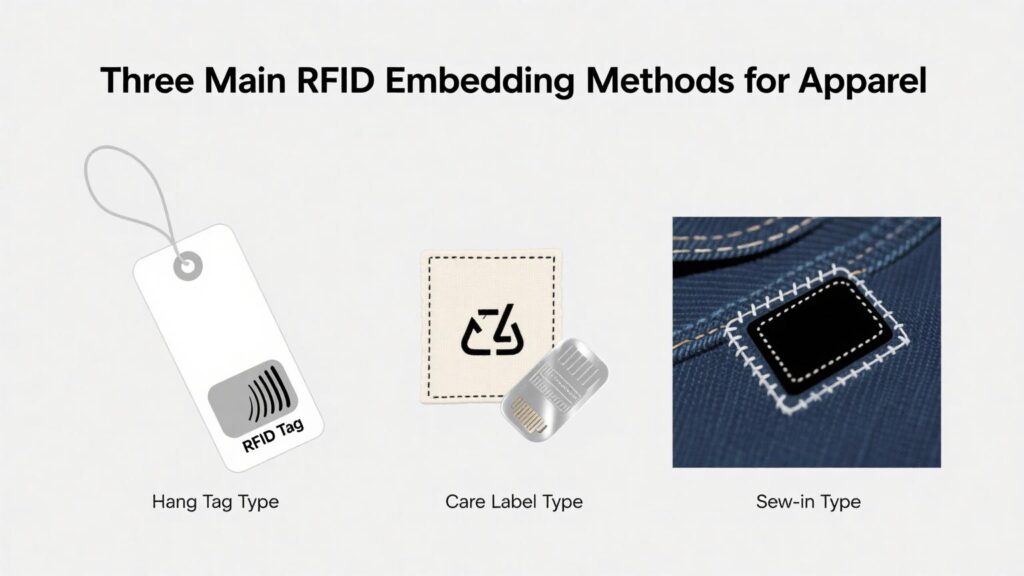
Currently, RFID tags in clothing are embedded in three common ways:
Hang Tag: Used for display and retail inventory, sold together with the garment.
Care Label: Sewn into care tags, offering strong concealment and durability.
Sewn-In Textile Label: Integrated directly into textile structures, washable and long-lasting.
Main Tag Types and Applicable Scenarios
Hang Tags Used in merchandise display, retail tracking, and outbound management. Easy to install and suited for one-time reading.
Laundry RFID Tags Common in hotels, hospitals, and uniform rental services. Designed for water resistance, high-temperature steam, and chemical corrosion resistance. Manufacturers like HID and GAO emphasize stable recognition after more than 10 wash cycles.
Flexible Sewn-In Tags Incorporate RFID chips as ribbons or fabric strips without affecting wearing comfort. Suitable for long-term apparel management, anti-counterfeiting, and identity binding, already adopted by multiple smart wearable startups.
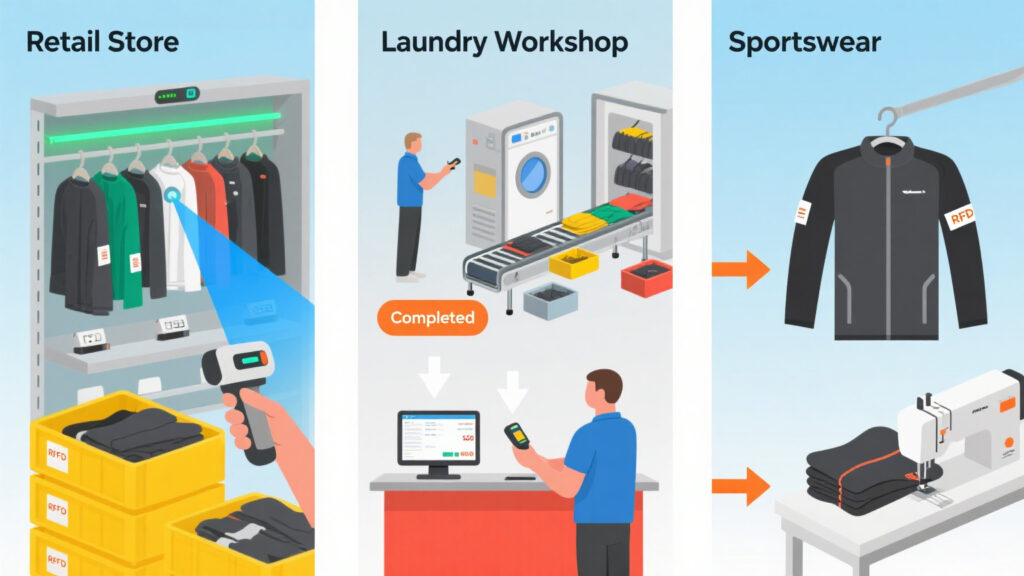
Core Application Scenarios of RFID Tags
Retail Stores and Inventory Management
Batch and fast inventory counts with accuracy above 99%.
Automated recording throughout goods inbound, outbound, and shelving.
Consumers can scan tags via apps to receive size recommendations and inventory distribution.
Commercial Laundry and Uniform Rental
Tracks washing cycles, sorting processes, and garment ownership.
Hospitals, hotels, and factories utilize tags for intelligent dispatch and receipt.
Supports batch reading, significantly reducing human error.
Smart Wearables
RFID paired with sensors to record temperature and motion data, forming smart wearable systems.
Consumers’ wearing triggers discounts, personalized recommendations, and enhanced experiences.
Some brands experiment with linking tags to user identities, realizing “clothing as an IoT gateway.”
Deployment Challenges and Considerations
Despite proven value, RFID clothing tags face several challenges in implementation:
Cost vs Scale: Small and medium brands often hesitate due to upfront investment.
Privacy and Transparency: Consumers worry about tracking and resist wearing permanent RFID.
Reading Interference: Metal accessories and stacked garments can disrupt signal stability.
System Integration Complexity: Requires backend ERP or WMS integration, with higher initial deployment costs.
Future Trends: The Intelligent Evolution of Clothing Tags
With the development of flexible circuits, washable materials, and flexible packaging technology, RFID tags are evolving towards thinner, recyclable, and environmentally friendly designs. Future trends include:
Blockchain Integration: Verifiable apparel traceability and lifecycle management.
Enhanced Consumer Interaction: Scanning triggers personalized content or purchase guidance.
Green RFID: Environmentally friendly tags made from biodegradable materials.
Conclusion
RFID is redefining the meaning of “tags”: no longer merely an accessory to goods, but a key node in digital management. From retail operations to smart wearables, RFID clothing tags are driving the entire apparel industry towards information-driven and data-closed loops. For enterprises, understanding RFID principles and deployment methods will lay a solid foundation for future competitiveness.
CYKEO Passive RFID Tags are made for wet and high-humidity environments where standard labels do not last. This rfid passive tag is often used around liquids, chemicals and temperature changes, providing stable reading distance and long data life for industrial tracking.
CYKEO CYKEO-PCB1504 Metal RFID Tags is a compact anti-metal UHF RFID solution built for direct mounting on metal surfaces. With stable 8-meter read range, Ucode-8 chip, and long data retention, this rfid metal tag fits tools, containers, automotive parts, and industrial asset tracking.
CYKEO CYKEO-PCB7020 On-Metal RFID Tags are designed for reliable tracking on steel and metal surfaces. Built with an FR4 epoxy body and industrial-grade chips, these On-Metal RFID Tags deliver stable performance, long data life, and chemical resistance, making them a dependable RFID anti-metal tag for harsh environments.
The CYKEO CYKEO-60-25 Anti-Metal RFID Tag is built for metal surfaces where standard tags fail. Designed for long-range performance, harsh environments, and stable data retention, this Anti-Metal RFID Tag is ideal for industrial assets, containers, and equipment tracking using on metal RFID tags.
On March 20th, Cykeo 2026 Spring Banquet was successfully held in a warm and lively atmosphere. The event, themed “Galloping Forward, United for Success,” focused on the company’s annual development direction: “RFID Connecting All Assets.” Company...
See how CYKEO UHF RFID Fixed Reader enables seamless system integration. Perfect for developers and solution providers needing secondary development, it fits logistics, manufacturing, access control, and asset tracking projects.
how RFID tags work, practical methods to test them using phones or dedicated readers, and their industrial applications. Learn about HF/NFC, UHF, and bulk RFID tag solutions for warehouses, access control, and asset tracking.
In today's fast-paced society, innovative shopping models such as unmanned stores and self-checkout systems are increasingly popular with consumers. At the heart of these innovations lies a key technology: Radio Frequency Identification (RFID). Cy...
 Cykeo RFID IoT Solution Products R&D Manufacturer