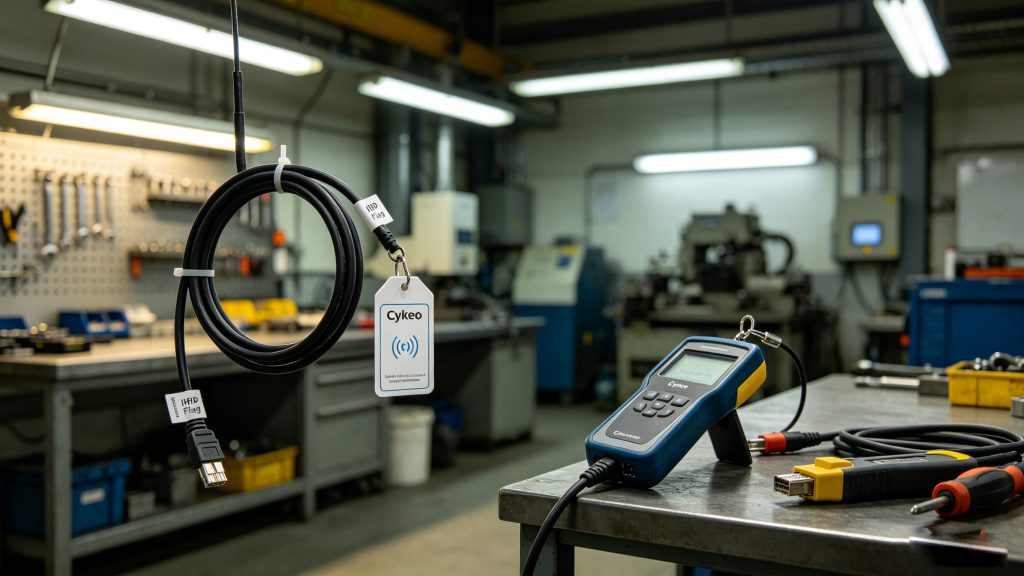
An RFID flag tag is a flexible ultra high frequency RFID label designed for curved, metallic, or difficult surfaces, enabling accurate long-range identification and faster inventory tracking in industrial environments.
The first time I saw a poorly installed RFID label fail, it was attached directly onto a bundle of medical cables inside a hospital storage room. The barcode remained visible. The RFID chip technically worked. But the read rate collapsed once the cables were packed tightly together.
That was the moment the installer realized ordinary flat labels were the wrong choice.
A proper rfid flag tag changes the physics of the read environment. Instead of laying fully against the surface, part of the label extends outward like a small flag, improving antenna performance and reducing signal interference. In ultra high frequency RFID deployments, that tiny structural difference matters more than most people expect.
At Cykeo, we have tested UHF RFID flag tags in tool management rooms, healthcare consumable cabinets, IT cable tracking systems, and industrial maintenance stations where standard RFID labels consistently underperformed.
What Makes an RFID Flag Tag Different?
Unlike conventional adhesive RFID labels, a flag tag folds around an object while leaving the RFID antenna portion suspended away from the surface.
That separation improves signal consistency.
This becomes especially important when tagging:
Network cables
Surgical tubing
Metal tools
Cylindrical assets
Industrial wires
Reusable containers
Why Standard RFID Labels Often Fail on Curved Surfaces
Flat RFID labels lose efficiency when wrapped tightly around narrow objects. Signal distortion increases, especially in environments with metal interference or densely packed materials.
A properly designed rfid flag tag creates a small air gap that helps the antenna maintain stable communication with the RFID reader.
According to RAIN Alliance, UHF RFID technology continues expanding across industrial automation because of its ability to support non-line-of-sight bulk identification and long-range reading capabilities.
In practice, though, tag placement still determines whether the system performs well.
How Cykeo Uses UHF RFID Flag Tags in Real Projects
One deployment still stands out.
We were assisting with RFID asset registration inside a maintenance department where technicians constantly borrowed diagnostic tools and portable electronic devices. Traditional barcode labels wore out quickly. Flat RFID stickers peeled near cable bends.
The switch to flexible UHF RFID flag tags stabilized read performance almost immediately.
Flexible UHF RFID flag tags improve cable identification efficiency.
Real Workflow Improvements We Observed
Process
Before RFID Flag Tags
After Deployment
Cable identification
Manual search
Instant RFID reading
Inventory speed
45 minutes
Under 6 minutes
Label replacement frequency
Monthly
Rare
Asset lookup disputes
Frequent
Traceable records
The improvement was not dramatic in appearance. The labels looked simple. But operationally, the workflow became quieter. Fewer interruptions. Less rechecking.
That is usually how successful RFID projects feel in real life.
Why UHF RFID Flag Tags Work Better in Dense Environments
Ultra high frequency RFID depends heavily on antenna orientation and surrounding materials.
That becomes obvious inside:
Server cabinets
Tool storage rooms
Healthcare supply cabinets
Manufacturing workshops
Warehouse shelving systems
Signal Stability in Crowded RFID Environments
Cykeo UHF RFID systems support ISO 18000-6C and EPC Gen2 protocols, allowing multiple tags to be identified simultaneously.
But dense environments introduce problems:
Reflection from metal
Absorption from liquids
Tag overlap
Signal shadowing
Flag tags reduce part of that interference by positioning the antenna more effectively away from difficult surfaces.
That design detail often determines whether inventory accuracy reaches operational standards.
According to GS1 RFID Standards, RFID deployment accuracy depends not only on readers but also on correct tag selection and placement strategies.
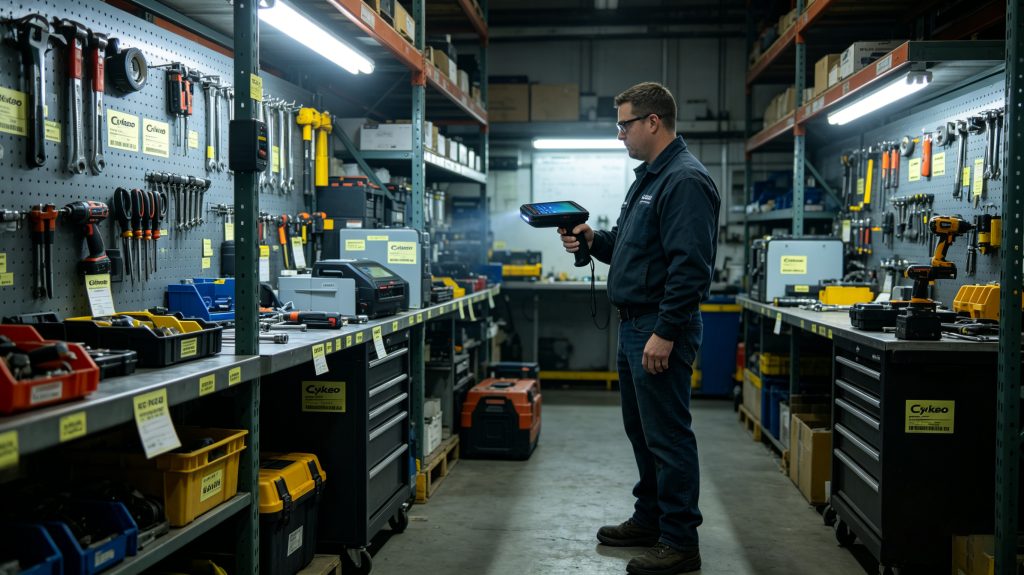
Cykeo RFID flag tags support fast and accurate inventory scanning.
Common Industries Using RFID Flag Tags
RFID flag tags are no longer limited to logistics warehouses.
We now regularly see them used in:
Industry
RFID Usage
Healthcare
Surgical tubing and consumables
IT Infrastructure
Server cable identification
Manufacturing
Tool and component tracking
Aviation
Maintenance asset management
Utilities
Wire harness traceability
Warehousing
Reusable container tracking
The healthcare sector has grown particularly fast.
A 2024 report from Deloitte Insights highlighted increasing healthcare investment in digital inventory visibility technologies, especially systems improving traceability and supply chain accountability.
RFID fits naturally into that transition.
Practical Installation Lessons Most Vendors Ignore
A surprising number of RFID issues are caused by installation shortcuts.
One client placed RFID flag tags directly beside metal fasteners because it looked visually cleaner. Read rates dropped immediately.
Moving the tags just a few centimeters restored detection stability.
That kind of detail rarely appears in marketing brochures, but it matters enormously in actual deployments.
RFID engineering is part hardware selection and part environmental tuning.
FAQ About RFID Flag Tag Technology
What is an RFID flag tag used for?
RFID flag tags are commonly used for tracking cables, tools, cylindrical assets, and items where flat RFID labels perform poorly.
Are RFID flag tags suitable for metal environments?
Yes. Properly designed UHF RFID flag tags improve signal performance around difficult surfaces, including partial metal environments.
What RFID frequency works best for long-range tracking?
Ultra high frequency RFID is widely used for long-range inventory and asset tracking because it supports bulk reading and fast identification.
Can RFID flag tags support automated inventory systems?
Yes. RFID flag tags are compatible with automated inventory systems, RFID cabinets, handheld readers, and fixed UHF RFID gateways.
inal Thoughts on rfid flag tag
The biggest advantage of a well-designed rfid flag tag is reliability under real working conditions.
Not laboratory conditions. Not empty demo rooms.
Real environments filled with metal, cables, movement, interference, and human error.
That is where ultra high frequency RFID systems either succeed quietly or fail repeatedly.
Cykeo focuses heavily on that operational reality — building RFID tracking solutions that continue performing after deployment day, not just during demonstrations.
This article explains how to properly install RFID stickers on various surfaces such as metal, plastic, and glass. Learn key installation techniques and common mistakes to ensure a stable and efficient RFID identification system.
UHF tags enable fast, long-range RFID identification for inventory, logistics, manufacturing, and asset tracking. Discover how Cykeo UHF tags improve visibility and efficiency.
Learn practical RFID read zone control methods for warehouse gates and industrial tracking systems. Discover how beam width, metal environments, and antenna placement affect RFID reading areas in real deployments.
 Cykeo RFID IoT Solution Products R&D Manufacturer