A lot of people use RFID every day, but when you ask how it actually works, things get a bit fuzzy. At its core, RFID is really about one thing:
energy transfer
Most RFID tags don’t even have a battery, yet they still respond. That only works because energy is being sent, received, and reflected in a very specific way. Let’s walk through it in plain English.
First thing to understand: RFID doesn’t just “read data”
Many people think a reader simply scans and pulls data from a tag.
In reality, the process looks like this:
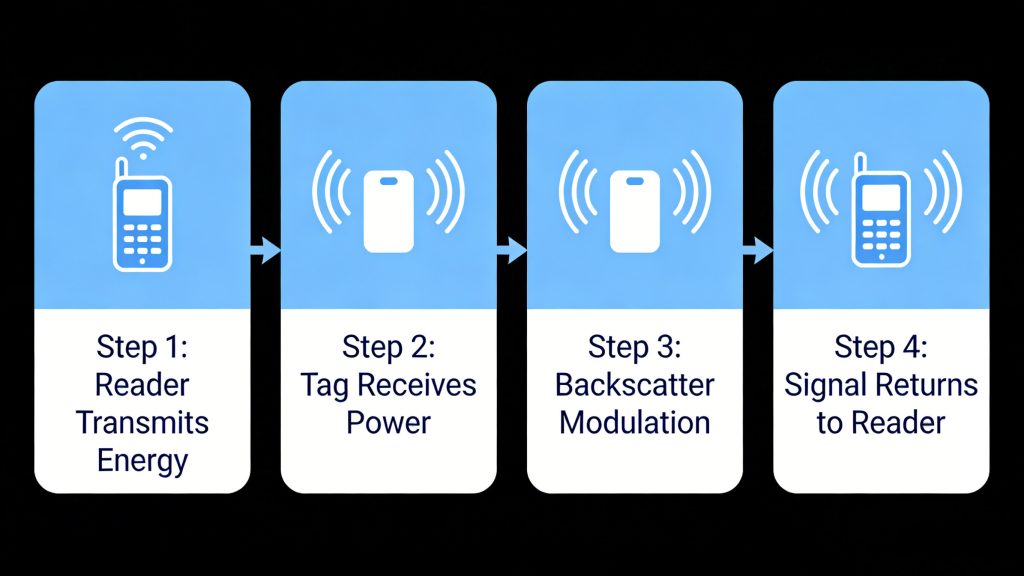
The reader sends out electromagnetic energy
The tag receives that energy and powers up
The tag sends information back
So the real flow is: energy → activation → data return
Without that first step (energy), nothing else happens.
How energy flows in an RFID system
Let’s break the process into simple steps:
1. The reader transmits energy (Reader → Air)
The RFID reader sends out electromagnetic waves through its antenna.
You can think of it as a wireless power source.
UHF: behaves like radio waves (longer range)
HF/NFC: more like a magnetic field zone (short range)
Key idea: broadcasting energy
2. The tag receives energy (Air → Tag)
When a tag enters this field:
Its antenna captures energy
The chip gets powered
The tag “wakes up”
This is basically wireless powering
That’s why most RFID tags don’t need batteries.
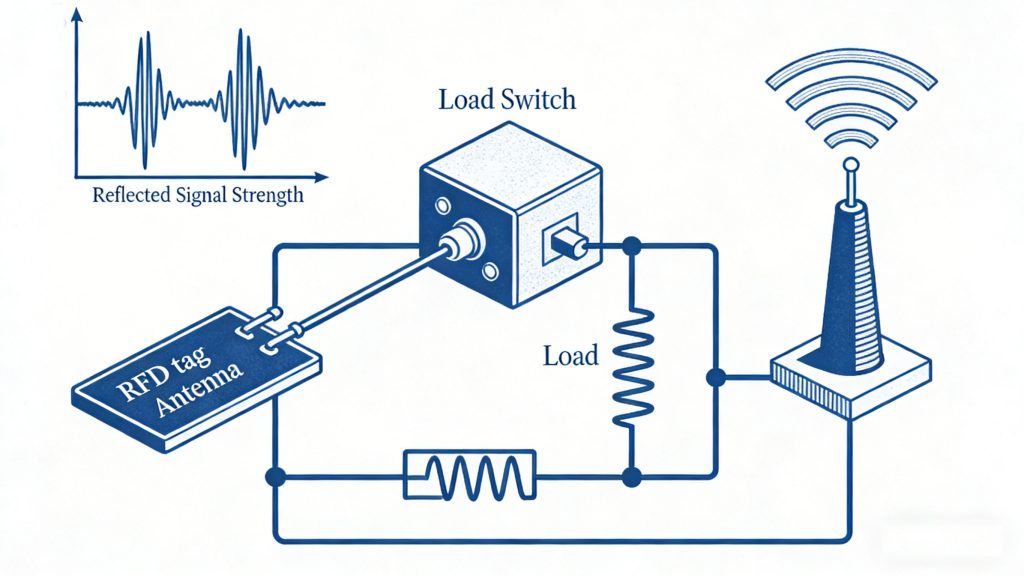
3. The tag modulates the signal (Inside the tag)
Once powered, the tag doesn’t actively transmit like a radio.
Instead, it does something smarter:
it changes how it reflects the signal
Specifically:
The chip switches the antenna load
This changes the reflected signal
Data is encoded in these changes
This process is called:
backscatter
4. The reader receives and decodes (Tag → Reader)
The reader picks up the reflected signal and decodes it into:
EPC
UID
User data
This step is basically signal interpretation
A simple way to picture it
Think of it like this:
The reader is a flashlight The tag is a mirror
Process:
The flashlight shines (energy)
The mirror receives the light
The mirror reflects it back in a controlled way
You interpret the reflection
RFID works in a very similar way.
Different frequencies = different energy behavior
Here’s the only slightly technical part, but we’ll keep it simple.
HF / NFC (13.56 MHz)
Uses magnetic coupling
Works like a transformer (near-field)
Short range (a few cm to tens of cm)
Pros: stable, less sensitive to environment Cons: short distance
UHF (Ultra High Frequency)
Uses electromagnetic waves + backscatter
Similar to wireless communication
Longer range (meters or more)
Pros: long range, multi-tag reading Cons: sensitive to environment (especially metal and liquids)
Why tags sometimes don’t read (energy perspective)
Most reading issues come down to one thing:
not enough usable energy at the tag
Common reasons:
1. Too much distance → Energy weakens before reaching the tag
2. Metal or liquid interference → Energy gets absorbed or reflected
3. Wrong tag orientation → Antenna doesn’t receive energy efficiently
4. Low reader power → Not enough energy transmitted
Simple way to think about it:
If the tag can’t get enough energy, it won’t respond.
What about active RFID (battery-powered tags)?
Quick mention:
Active tags:
Have their own power source
Can transmit signals actively
Offer longer range
But:
Higher cost
Require maintenance
That’s why most systems still use passive RFID.
Final thoughts
A lot of RFID problems seem complicated if you only look at software or configuration.
But if you step back and think in terms of energy flow, things become much clearer:
Is there enough energy? Is the energy being blocked or absorbed? Is the tag receiving it properly?
These three questions explain most real-world issues.
If you’re working on an actual project — warehouse, production line, or access control — focus on:
Antenna placement
Power settings
Tag selection
At the end of the day, you’re really just optimizing how energy moves through the system.
Once you understand that, troubleshooting RFID becomes much easier.
Most iPhones can only scan NFC tags, If you need real RFID UHF tag reader ,the iPhone needs extra hardware. Here is how the Cykeo CK-R10A plugs that gap and turns your phone into a practical UHF RFID tool.
how long-range RFID readers work, what affects their reading distance, and where they’re making automation smarter — from logistics to industrial systems
Discover the top 10 advantages of UHF RFID readers for supply chains in 2024. Boost efficiency, accuracy, and ROI with Cykeo’s cutting-edge RFID solutions.
Discover waterproof handheld RFID scanners built for rugged outdoor environments. Learn how Cykeo’s durable devices enhance accuracy in harsh weather and dust.
 Cykeo RFID IoT Solution Products R&D Manufacturer